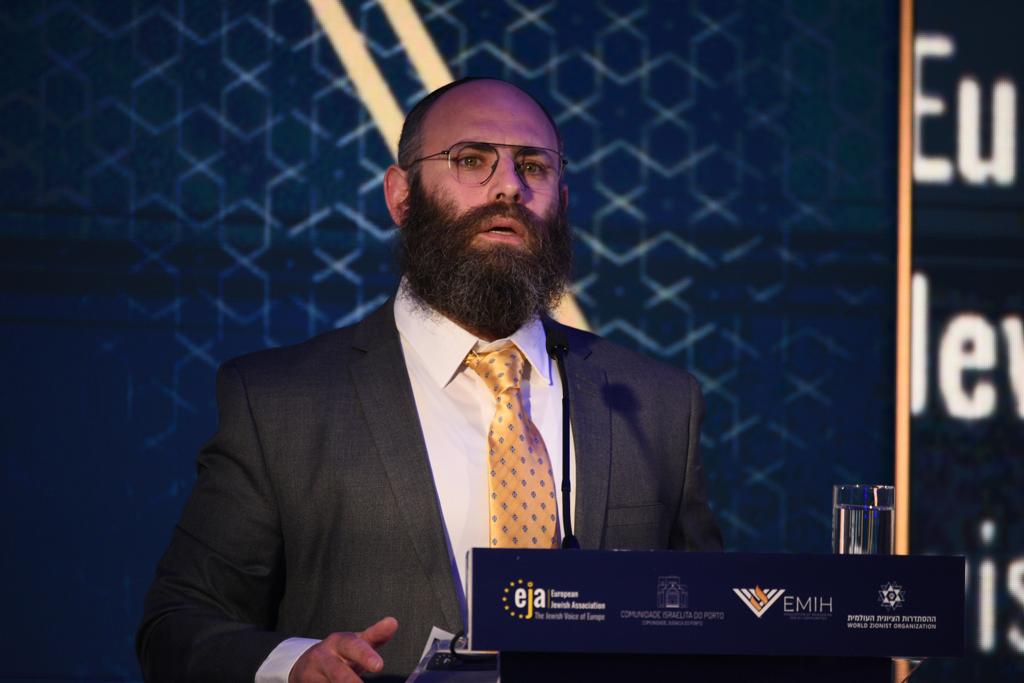

With war in Gaza and Europe-wide Antisemitism peak, Jews bring president Von der Leyen and other friends in Brussels to ‘shine together’ on Channukah

“Defiant and hopeful, just as we have always been,” says organisers of EU event after traumatic few months. Chanukah is first significant Jewish holiday since events on October 7th.

(Brussels 7 December 2023) European Commission President Ursula Von Der Leyen and other European Dignitaries will be at EuroChannukah 2023, taking place between the European Council and Commission buildings at Schuman in Brussels, Belgium on Sunday evening. The Commission President will light a giant Menorah marking the Jewish Holiday of Chanukah – the festival of light.

The theme of EuroChannukah this year, which takes place in the heart of the European Quarter, is ‘Shining Together’.

Chanukkah this year takes place against the backdrop of huge spikes in antisemitism and is the first major Jewish holiday following the Hamas Massacre in Israel and subsequent war in Gaza. The organisers, the European Jewish Community Center , say that it is a showcase for unity and resilience in difficult times.

Avi Tawil, Director of the European Jewish Community Centre, speaking ahead of the event said,

“We were concerned that this year, we would hear from communities across Europe that they were scaling down Chanukah celebrations, hiding away, keeping their heads down. In fact, the opposite is true, now more than ever, the desire is to come out and celebrate the holiday. To Shine together.

“Chanukah, at its core, is a holiday about light overcoming darkness, that good can and will always prevail. Our friends, like Commission President Vpn Der Leyen, are standing with us in solidarity, in a common bond, and in this spirit of unity and resilience.

“It’s been an awful few months. But Jews are defiant in the face of darkness, and always hopeful in the light, just as we have always been, and especially during Chanukkah.”

Ends.
Additional Articles

MOLDOVA AND JEWS – SURVEY SHOWS COUNTRY HAS DEEP-ROOTED ANTISEMITISM PROBLEM

In first detailed country study for Moldova, 36% of respondents feel Jews use dishonest means to achieve aims, 19% have a negative perception of Jewish people and around 14% “really don’t like them” Other concerning findings: 32% say Jews exploit non-Jews and 36% Jews seek to gain advantage from the Holocaust and 37% said that Jews talk too much about it.  

(Brussels 5 March 2024) The Brussels-based European Jewish Association (EJA), representing hundreds of Jewish Communities across the continent, and Budapest-based Action and Protection League today published a comprehensive report on antisemitic attitudes in the Republic of Moldova, as part of shared efforts to get an accurate continent-wide picture of current attitudes towards Jews.  

The land-locked country of 2.5 million citizens has a small Jewish population of around 1,900, equating to 0.7% of all citizens, which, says EJA Chairman Rabbi Menachem Margolin, shows an irrational and alarmingly high prevalence of antisemitic attitudes.  

The survey, conducted between October 20th and November 14th, 2023, gathered 923 valid responses from the adult population of Moldova. The study utilized a stratified, probabilistic sampling method to ensure the sample’s representativeness. 

The Moldovan government has taken some actions in combatting antisemitism such as adopting the IHRA definition and changing the penal code to include the promotion of fascist, racist or xenophobic ideologies, public denial of the Holocaust, glorification of exponents of fascism/Nazism and the use in public or for political purposes of fascist, racist or xenophobic symbols.  

Speaking as the survey was published, Rabbi Menachem Margolin, Chairman of the European Jewish Association said today: “The Moldova survey on antisemitism is part of our ongoing efforts to properly map the situation affecting Jews across the continent. “It is sadly clear that – despite some government efforts – deep-rooted antisemitism persists in Moldova. There can be no rational explanation as to why a community that represents such a tiny fraction of the overall population bears the brunt of such an alarmingly high number of stereotypes and tropes.  

“It will take much more than the adoption of the IHRA definition and changes to the legal code to make an impact on the antisemitic attitudes present in the Country. Change in the classroom is as a matter of urgency, if not the next generation will perpetuate and carry the virus of antisemitism with them. The Moldovan government has a tough road ahead in eradicating these old antisemitic attitudes that have no place in any modern country, especially one that seeks to join the European Union.” Ends  

EUROPEAN JEWISH ASSOCIATION IN EUROPE-WIDE CAMPAIGN TO HOUSE JEWISH REFUGEES FROM UKRAINE

Initiatives connects fleeing Ukrainian Jews with Jewish homes across the continent for temporary shelter. Association is also providing pick up of clothing.
As the war in Ukraine enters a second week, Europe is witnessing a huge influx of refugees fleeing Ukraine towards the West. Naturally many Ukrainian Jews are included in this surge to safety.
The Brussels-based European Jewish Association (EJA), representing hundreds of communities across the continent, has launched a Europe-wide campaign to temporarily provide homes, food and clothing to hundreds of Jewish families whose lives have been torn-apart and up-ended by the conflict in Ukraine.
The appeal has gone out to Jewish Communities from Lisbon to Lublin, Bucharest to Bordeaux and everywhere in between.
Speaking after launching the campaign, EJA Chairman Rabbi Menachem Margolin said,
“The history of the Jewish people is one of displacement, either because of pogrom or war. We are only too aware of what it means to be forced to up-and-leave at a moment’s notice. In almost every one of our communities you will hear such stories. From generations ago from Spain or Galicia, from the war, to emigrating to Israel. I say this because we are especially attuned to these catastrophes. And because we are so attuned, we are pre-programmed to help our Jewish neighbours, just as we always have.
“I have faith that this campaign will deliver. Since the war started Jews from all over Europe have been getting in touch with us to see what can be done to help their Ukrainian Jewish brothers and sisters in need. We are providing them with the vehicle to do just that, by offering shelter, food and clothing to those who left in a hurry, often with nothing but the clothes on their backs.”

EJA hosted a special meeting with Ambassador Rabbi Yehuda Kaploun, US Special Envoy to Monitor and Combat Antisemitism

We were honoured to host a special meeting with Ambassador Rabbi Yehuda Kaploun, US Special Envoy to Monitor and Combat Antisemitism alongside EJA Chairman Rabbi Menachem Margolin

The meeting was joined by EU ambassadors and diplomats. Ambassador Kaploun shared with our esteemed guests the current situation of antisemitism in Europe and the US, how Jewish communities feel and what they have experienced, and his views on how we can combat antisemitism together. The discussion underscored the importance of addressing the rise of antisemitism collectively. We wish to thank Ambassador Kaploun for this meeting and our guests, Ambassador Avi Nir-Avi Nir-Feldklein, Mission of Israel to the EU & NATO, Ambassador Martin Hojni, Permanent Representation of Austria to the EU , Ambassador Martin Schäfer, Permanent Representation of Germany to the EU,  Ambassador Andrea Orizio, Permanent Representation of Italy to the EU, Ambassador Sofia Grammata, Embassy of the Hellenic Republic to the Kingdom of Belgium,  Ambassador Helen Kaljuläte Embassy of the Republic of Estonia to the Kingdom of Belgium,  for joining us, for caring about combating antisemitism and for raising very important points during the discussion.

The meeting was organized by EJA Director of EU Relations Ruth Daskalopoulou Issac.

EJA Delegation to Auschwitz November 2025

This year, our delegation to Auschwitz was more vital than ever. For over two years, Jewish communities across Europe and around the world have faced unprecedented levels of antisemitism, escalating from hate speech to physical violence and even murder. We have said it before: antisemitism did not end with the liberation of Auschwitz. It never died!

This year, we came to a painful realization: we can no longer simply ask, call, or plead with leaders to act against antisemitism. We cannot continue living behind walls, concrete barricades, and constant police protection around every Jewish institution. Stronger measures are needed, along with a new definition and framework of protection.

That is why this delegation was so vital. During this year’s gathering, EJA Chairman Rabbi Menachem Margolin called on Europe to finally recognize Jewish communities as a protected minority, with all the legal safeguards such recognition entails.

This year, we gathered in Krakow just days before the 87th commemoration of Kristallnacht ,the Night of Broken Glass, to honor the memory of the victims, to stand against hatred and antisemitism, to reject Holocaust denial and justification, and to say in one clear voice: the fight against antisemitism is not only a Jewish issue, it is a European one.

We wish to thank all our guests who traveled from near and far to join us , to listen, to remember, and to learn not only about the horrors of Auschwitz’s past but also about the troubling reality of today.

Our deepest gratitude goes to former UK Prime Minister Boris Johnson for joining us in Auschwitz and for his steadfast support of the Jewish people and communities worldwide. We also thank our dear friends, partners, and every guest who continues to stand by us and support our efforts over the past two years and beyond.

Additional Communities
United State
United Kingdom
Ukraine
Turkey
Schweiz
Switzerland
Sweden
Spain
Slovenia
Slovakia
Serbia