The Start of Council of Jewish Leaders in Rome

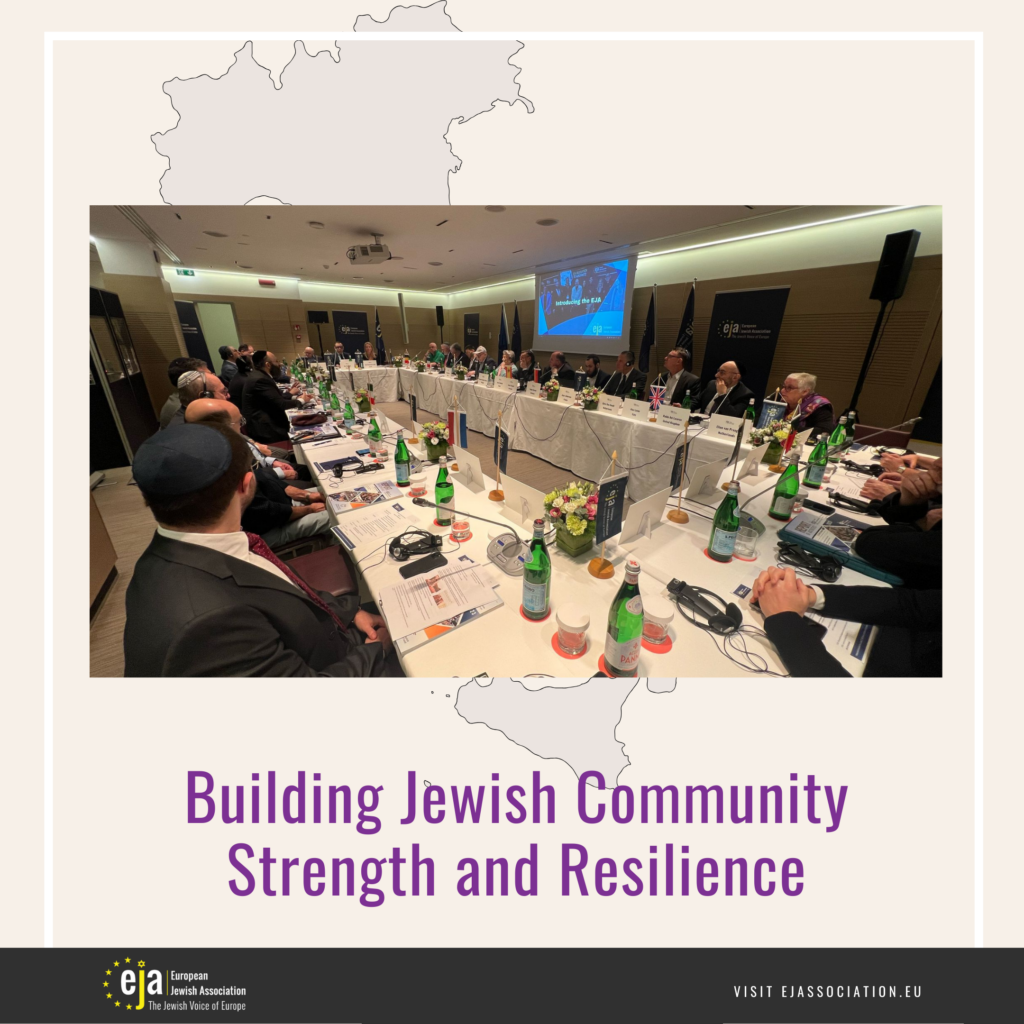
We are excited to kick off the Council of Jewish Leaders in Rome.
Our goal is to bring together leaders from diverse Jewish communities to tackle the urgent challenge of increasing anti-Semitism. Discussions will focus on each community’s efforts, enhanced security measures, and insightful insights.
This gathering holds great importance as we unite to confront this concerning trend. Noteworthy speakers and influential stakeholders will delve into these critical topics.

Additional Articles

Meeting with MK Uzi Dayan and Heads of Jewish Organizations

The President of the Belgian Consistoire, the Chair of Belgian Friends of Israel and the Director of the Belgian league against antisemitism met this afternoon at EJA headquarters for an open briefing and discussion with MK Uzi Dayan, Former deputy chief of staff of the IDF and nephew of the late Moshe Dayan who was accompanied by Oded Viner, former CEO of the chief Rabinate of Israel.
Among the subjects discussed were challenges faced by European Jewry, anti-Israelism in Europe and the situation in the Middle East with a strong emphasis on Iran. General Dayan presented some ideas to take back to the Knesset to strengthen European Jewry that may be revealed in due course.

Thousands in Budapest flock to Jewish street fair in sign of community’s revival

In scene uniting Jews of all denominations, some 10,000 brave thunderstorm to throng Hungarian capital’s touristic Kazinczy street for annual Judafest

BUDAPEST – Thousands flocked to Budapest’s Kazinczy street in the heart of the historic Jewish ghetto on Sunday to celebrate the city’s Judafest.
Braving an afternoon downpour, tourists and locals alike visited the massive street festival, which annually showcases all things Hungarian and Jewish. It’s quite a coup for a central European Jewish community still recovering from World War II and decades of Communism.
The thoroughfare, a common tourist destination throughout the year, teemed with both Jewish and non-Jewish onlookers who stopped at the dozens of stalls offering traditional Jewish foods, handmade items for sale, and information on the multitude of religious and community initiatives that operate in Hungary and the surrounding areas.
Parents pushed baby carriages and walked hand-in-hand with children who sported brightly colored face paint and clutched balloons decorated with the logos of Jewish organizations.
“I think we have even more people than last year,” festival organizer Pepe Berenyi told The Times of Israel. Berenyi, who is also the deputy director of Budapest’s Balint House JCC, estimated that 9,000 to 10,000 people had passed through the festival by mid-afternoon.
Judafest perennially brings together congregations and organizations from all walks of Hungarian Jewish life and across secular and all religious denominations — no mean feat for any Jewish community. The festival was organized by Budapest’s Balint House JCC and the American Jewish Joint Distribution Committee, and featured over 30 partners from across the community.
This year also saw significant representation from the country’s periphery and Israel, including the towns of Koszeg, on the Austrian border, and Komarom, on the border with Slovakia – in keeping with the festival’s theme of “Hungarian-speaking Jewish communities.”
A secular humanitarian organization set up shop across from Chabad Hasidic emissaries who gave passersby the chance to say a short prayer with a set of phylacteries. Representatives from many of the city’s various synagogues lounged together amid the many food stands offering tastes of traditional Jewish fare ranging from cholent to freshly baked challah to plates of Israeli hummus.
In the late afternoon, the sunshine gave way to heavy gray storm clouds when a not-completely-unexpected thunderstorm struck. But revelers stuck it out, huddling with umbrellas for half an hour in stone alcoves along the alleyway. As the rain finally started to let up, a handful of teenagers with matted hair took back to the street and danced in their wet clothing to Israeli music that continued to play from a nearby stall.
“Well, it was a great six hours,” joked a resilient Berenyi, who worked for months to put the festival together.
But despite some setbacks – the amplification system and other electronics were taken out of commission by the storm – visitors did not seem deterred. Stall owners bailed out water, dried off their merchandise, and went back to serving the many attendees who stuck around.
A planned concert went forward as an acoustic performance, and the three singers made up for the lack of a sound system by asking the audience to accompany them, turning the show into a sing-along.
At 19:48 Israeli time, to correspond with the year Israel was established, 70 community dignitaries released dove-shaped balloons in honor of Israel’s 70th year of independence.
Onstage, Balint House JCC director Zsuzsa Fritz sang “Lech L’cha,” by singer Debbie Friedman, citing the song’s significance.
“The song is taken from the biblical passage where God first commands Abraham to go to Israel, and promises to bless his offspring and make them into a great nation,” Fritz later told The Times of Israel. “I really felt that this was especially appropriate here as we continue to grow our community.”
Fritz said that the event was an incredibly effective outreach tool, and could encourage many people to engage with Budapest’s Jewish communal life who otherwise wouldn’t take the initiative.
Berenyi said that in Judafest’s inaugural year, Hungarians were hesitant about street festivals of any type – let alone obviously Jewish ones. In all, there were seven partners that first year, and, unexpectedly, the daylong festival was a huge success, drawing 2,500 people.
But in recent years, Judafest has grown considerably, attracting dozens of partners and drawing 12,000 attendees.
Fritz cited an impact study that the Balint House JCC conducted at the event, with pollsters asking attendees questions related to their levels of Jewish participation.
“I was walking by and overheard one of our surveyors speaking to a woman of about 60,” Fritz told The Times of Israel.
“She asked the woman if this was the sole Jewish event that she attended this year, and to my surprise, the woman answered yes,” Fritz said.
“I was sure that she looked like she participated more regularly – in this business you get a feel for these things – but this just shows that events such as this are of the utmost importance and can bring people into the fold who otherwise would feel insecure.”
The article was published on The Times of Israel

National Jewish Assembly (NJA)

The National Jewish Assembly (NJA) is a prominent organisation dedicated to serving the Jewish community in the United Kingdom. With a robust commitment to advocacy, education, and community engagement, the NJA plays a pivotal role in advancing Jewish interests and promoting cultural heritage.

Through strategic initiatives and collaborative efforts, the NJA actively addresses key issues affecting the Jewish population, including combating antisemitism, advocating for religious freedom, and fostering interfaith dialogue. With a firm stance against discrimination and intolerance, the NJA champions the rights and well-being of Jewish individuals and communities nationwide.

The NJA takes pride in its comprehensive educational programmes, which aim to deepen understanding of Jewish history, tradition, and values among both Jews and non-Jews alike. Through seminars, workshops, and publications, the NJA empowers individuals to embrace and celebrate Jewish identity while promoting mutual respect and understanding across diverse communities.

At the heart of its mission, the NJA fosters a strong sense of community and belonging among Jews throughout the UK. By organising cultural events, social gatherings, and networking opportunities, the NJA cultivates meaningful connections and strengthens bonds within the Jewish community.

In summary, the National Jewish Assembly stands as a formidable advocate and champion for Jewish rights, education, and community cohesion in the United Kingdom, ensuring a vibrant and thriving future for generations to come.

https://nja.org.uk/

A special message for Yom Kippur from EJA Chairman, Rabbi Menachem Margolin.

Additional Communities
United State
United Kingdom
Ukraine
Turkey
Schweiz
Switzerland
Sweden
Spain
Slovenia
Slovakia
Serbia