Open Letter MEPs to HRVP Borrell on Qatar

December 15, 2023

Strasbourg, 1 4 December 2023

It is now sadly over 10 weeks since the Hamas inhumane massacre in Israel and the abduction of civilian hostages, including babies, infants, women, elderly and medically unfit people.

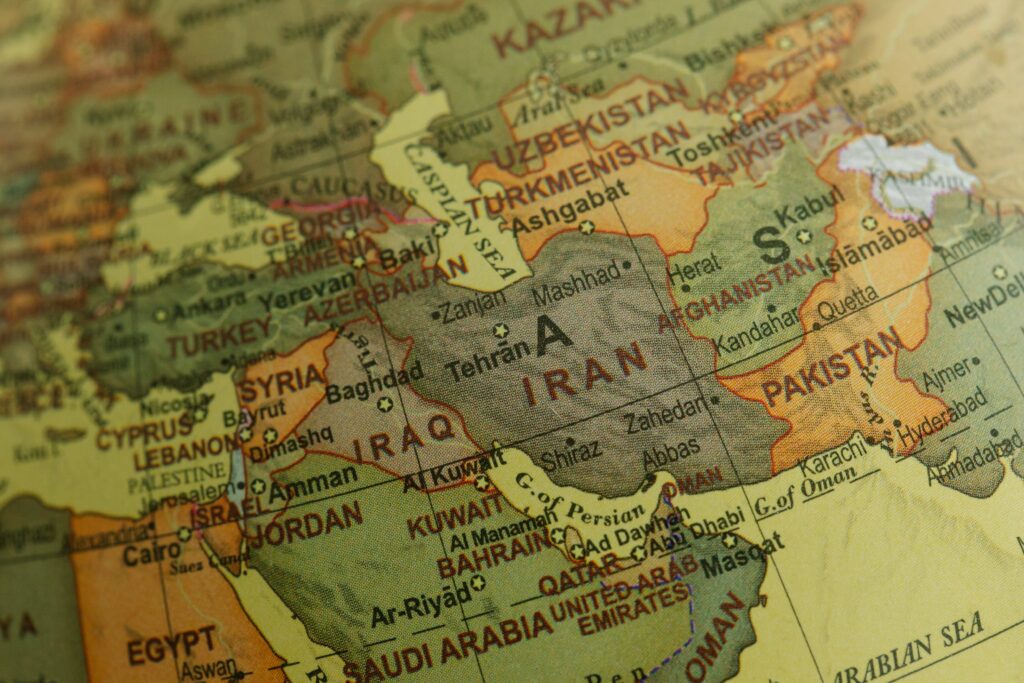
We, the undersigned Members of the European Parliament, urge your attention on the role of Qatar and their explicit support of Hamas. Both in providing financial assistance of billions of euros over the years but also in harbouring the leadership of Hamas, who live in luxury in Doha with 24-hour security provided by Qatar.

Despite its recent mediation efforts, Qatar could simply pressure Hamas more today to release the remaining hostages and be part of the solution, instead of part of the inhumane problem of terrorism.

As High Representative for the Union on Foreign Affairs, the Qatari government must be reminded that their support for Hamas and terrorism, will affect its future relations with the European Union. We must make clear to Qatar and every other entity in the region that human rights come first, before any business dealings.

Both the Statement of the Members of the European Council of 15 October 20231 and the European Parliament Resolution P9_TA(2023)0373, adopted on 19 October 20232, call for Hamas to “immediately release all hostages” and note “that the taking

of hostages is a violation of international law and constitutes a war crime.

Furthermore, the rhetoric and actions of Qatar contribute towards the incitement and violence that Jewish people are experiencing here in Europe. Following the terror attack of 7 October, antisemitic attacks and hate speech have multiplied by over 1000%. Jewish communities live under fear and are being assaulted, in many instances, by supporters of Hamas on the continent.

The scale and brutality of the attacks, which are some of the worse since the Holocaust, must be a turning point. We no longer can accept that it will be ‘business as usual’.

We call upon you to ensure that Qatar and all key partners put the utmost pressure possible for the safe release of all the hostages as a priority.

We thank you for your consideration and look forward to your update regarding this issue.

Yours sincerely,

Additional Articles

Eurovision song contest in Malmo: Israel’s National Security Council upgrades travel warning for the Swedish city

Malmo, which has a high concentration of Syrian, Lebanese, Iraqi and Iranian migrants, is known as a focus for anti-Israel protests, which occur on a weekly basis and frequently include incitement, calls to attack Jews and Israelis and the burning of Israeli flags.By EJP and JNSThe 2024 Eurovision Song Contestwill be held in the Swedish city of Malmo on 7-11 May.In light of this event, the National Security Council (NSC) is upgrading the travel warning for Malmo (but not the travel warning for Sweden as a whole) from Level 2 (potential threat) to Level 3 (moderate threat) and recommends that Israelis due to arrive in the city reconsider the necessity of the trip.The travel warning is for the period of the Eurovision and is subject to an assessment of the situation.Malmo, which has a high concentration of Syrian, Lebanese, Iraqi and Iranian migrants, is known as a focus for anti-Israel protests, which occur on a weekly basis and frequently include incitement, calls to attack Jews and Israelis and the burning of Israeli flags.It should be noted that on October 7, anti-Israel elements were openly joyful over the massacre that Hamas perpetrated in Israel.In addition to the protests in Malmo, in recent months there has been an upsurge in calls by global jihadist and radical Islamic elements to carry out attacks against Western targets, including focused threats against Israelis and Jews around the world, while emphasizing targets with a high media profile. It should be noted on 19 March, the arrest of ISIS operatives who were planning to carry out an attack on the Swedish parliament.These developments raise the tangible concern that terrorists will exploit the protest and the anti-Israel atmosphere to carry out an attack on Israelis who will arrive for the Eurovision, the NSC said.While the Swedish authorities have increased security in Malmo, it should be noted that unlike the Israeli delegation to the contest, Israeli visitors will not receive special security.Visitors to Malmo are requested to download the IDF Home Front Command app in order to receive NSC updates quickly and in real-time in the event of an incident in Malmo during the Eurovision.Israeli contestant Eden Golan prepares for the compeition Meanwhile, Israeli Eurovision contestant Eden Golan landed in Malmo on Tuesday to prepare for the competition.“I feel like the main message is that we are here, we are strong, we will show our voices, the warmth, the strength and the emotion that we have inside us,” Golan told JNS.“There are truly so many people who support us, people who like the song, are there for us and love us. We are a huge family and we want to spread good, love and unity,” she added.The Eurovision Song Contest is an internationally televised songwriting competition comprising three live shows: two semi-finals and a grand final.All songs must be original and no more than three minutes in length. Lead vocals must be performed live, and no more than six performers can take to the stage during any one performance.In each show, after all songs have been performed, each country participating awards two sets of points (1, 2, 3, 4, 5, 6, 7, 8, 10 and 12) to their favorite songs; one set is awarded by a jury of five music industry professionals and one is awarded by viewers.The five countries in each semi-final with the most points advance to the grand final.Last year, Israeli pop star Noa Kirel finished in third place in the Eurovision final in Liverpool, behind Sweden and Finland. She was aiming to become the fifth Israeli to win the song contest since the Jewish state first entered the annual event in 1973 and the first since Netta Barzilai and her song “Toy” won in 2018.Past winners include Izhar Cohen and Alphabeta in 1978, with the song “A-Ba-Ni-Bi,” Milk and Honey in 1979 with “Hallelujah” and Dana International in 1998 with “Diva.”This year, Eden Golan, 20, will represent the Jewish state in the second semifinal on May 9. The grand final will take place on May 11.The coming days will be busy ones for Golan.“Each day revolves around Eurovision, from rehearsals and vocal lessons to interviews, photoshoots and fittings to prepare the wonderful outfits that I will be wearing on stage,” she said.“I am concentrating on our goal: to give a great performance, and I am constantly working towards it,” she added.Organizers of the Eurovision Song Contest reaffirmed in February that Israel would be allowed to compete despite calls to exclude it from the competition.“Of course, there were thoughts and uncertainties at certain points. I don’t think I really let it get to me. I was very focused, I truly wanted to believe that we would be there on stage, I visualized it, I just saw myself performing on stage,” said Golan.“Good thoughts, good vibes, good energy; here we are now,” she added.Rejecting parallels drawn by pro-Palestinian activists with Russia’s exclusion from the competition over its invasion of Ukraine, Noel Curran, director-general of the European Broadcasting Union (EBU), said that “comparisons between war and conflict are complex and difficult and, as an apolitical media organization, it is not our place to make them.”In March, Israel’s Kan public broadcaster revealed the Jewish state’s final entry for this year’s contest, after the EBU had threatened to disqualify two earlier entries over perceived political messaging. A week earlier, the EBU informed Israel that Golan would be allowed to compete with “Hurricane.”“When we finally got the news that everything was sorted out, it was amazing, it felt like a weight was lifted off my shoulders,” said Golan.“It was exciting, heartwarming and uplifting because I really think that this year more than ever it’s important for us to be there on stage and show our voice,” she added.The last lines of “October Rain,” one of Israel’s earlier entries, described the condition of Israelis during the Oct. 7 terror attacks, in which 1,200 people were slaughtered: “There’s no air left to breathe / No place, no me from day to day.”In one of the verses, Golan sang the word “flowers,” which is Israel Defense Forces slang for fallen soldiers, but which does not carry that connotation for European viewers.Israel’s second-choice song, “Dance Forever,” was an apparent reference to the massacre at the Supernova music festival near Kibbutz Re’im, where Hamas terrorists murdered 364 people on Oct. 7.Kan has said that the final submission, set to the tune of “October Rain,” tells the story of a “young woman who is surviving a personal crisis.”“Honestly, when the news got out to me that they did not want to approve the song, I was shocked, to say the least,” said Golan. “Now that it’s done, I’m not looking back. I know that we have a great song that will represent us proudly and that’s all that matters,” she continued.“I am very happy with the final product. I think we have a great, powerful and emotional song that conveys so many feelings, in which every single person can find themselves and connect to it in some way or another,” Golan added.She told JNS she is well aware of the worldwide surge of antisemitism.In March, a London movie theater threatened to cancel the screening of the Eurovision Grand Final if Israel remains in the competition, according to Deadline.The Rio Cinema in East London, known for its ties with Eurovision Party London, declared the decision via social media, and added that it will continue to support Palestinian charities.“I am not naive. I know what is going on in the world. It’s not something we can really hide from,” said Golan.“I wouldn’t say I’m scared, because I will be taken care of and the whole delegation is going to be taken care of as well. Once again I am very focused on our main goal: to give a great performance. We can’t run away from reality, sadly, but we can focus on the good,” she added.

Link: https://ejpress.org/eurovision-song-contest-in-malmo-israels-national-security-council-upgrades-travel-warning-for-the-swedish-city-mo-sweden/

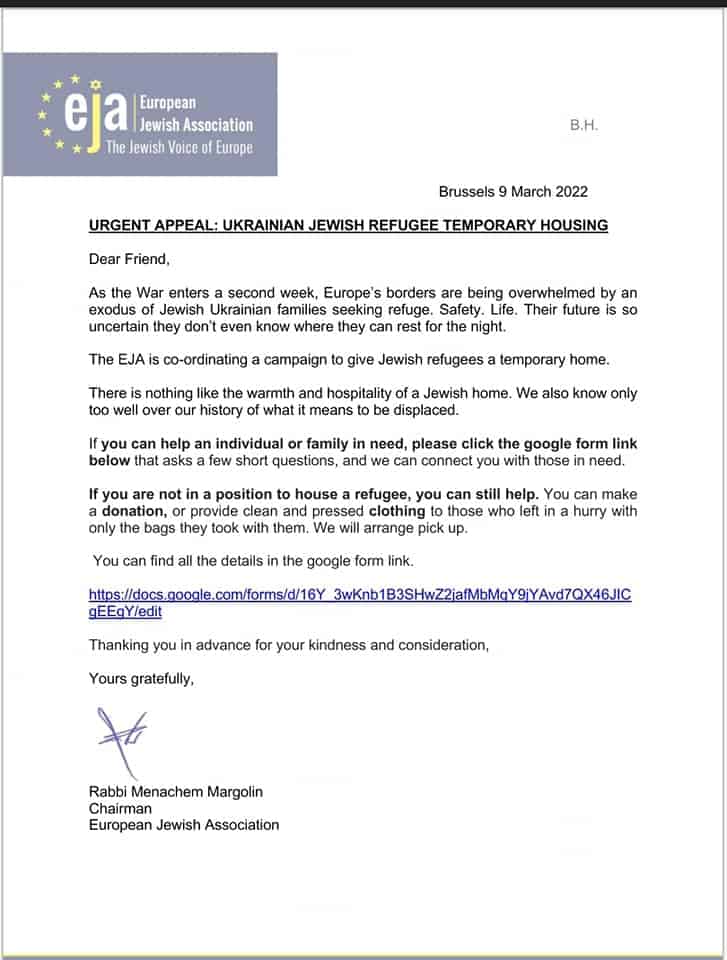
EUROPEAN JEWISH ASSOCIATION IN EUROPE-WIDE CAMPAIGN TO HOUSE JEWISH REFUGEES FROM UKRAINE

Initiatives connects fleeing Ukrainian Jews with Jewish homes across the continent for temporary shelter. Association is also providing pick up of clothing.
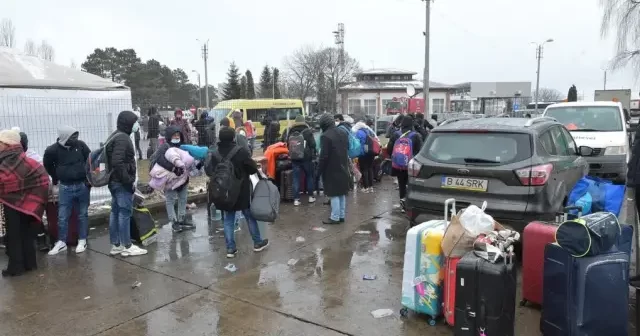
As the war in Ukraine enters a second week, Europe is witnessing a huge influx of refugees fleeing Ukraine towards the West. Naturally many Ukrainian Jews are included in this surge to safety.
The Brussels-based European Jewish Association (EJA), representing hundreds of communities across the continent, has launched a Europe-wide campaign to temporarily provide homes, food and clothing to hundreds of Jewish families whose lives have been torn-apart and up-ended by the conflict in Ukraine.
The appeal has gone out to Jewish Communities from Lisbon to Lublin, Bucharest to Bordeaux and everywhere in between.
Speaking after launching the campaign, EJA Chairman Rabbi Menachem Margolin said,
“The history of the Jewish people is one of displacement, either because of pogrom or war. We are only too aware of what it means to be forced to up-and-leave at a moment’s notice. In almost every one of our communities you will hear such stories. From generations ago from Spain or Galicia, from the war, to emigrating to Israel. I say this because we are especially attuned to these catastrophes. And because we are so attuned, we are pre-programmed to help our Jewish neighbours, just as we always have.
“I have faith that this campaign will deliver. Since the war started Jews from all over Europe have been getting in touch with us to see what can be done to help their Ukrainian Jewish brothers and sisters in need. We are providing them with the vehicle to do just that, by offering shelter, food and clothing to those who left in a hurry, often with nothing but the clothes on their backs.”

National Jewish Assembly (NJA)

The National Jewish Assembly (NJA) is a prominent organisation dedicated to serving the Jewish community in the United Kingdom. With a robust commitment to advocacy, education, and community engagement, the NJA plays a pivotal role in advancing Jewish interests and promoting cultural heritage.

Through strategic initiatives and collaborative efforts, the NJA actively addresses key issues affecting the Jewish population, including combating antisemitism, advocating for religious freedom, and fostering interfaith dialogue. With a firm stance against discrimination and intolerance, the NJA champions the rights and well-being of Jewish individuals and communities nationwide.

The NJA takes pride in its comprehensive educational programmes, which aim to deepen understanding of Jewish history, tradition, and values among both Jews and non-Jews alike. Through seminars, workshops, and publications, the NJA empowers individuals to embrace and celebrate Jewish identity while promoting mutual respect and understanding across diverse communities.

At the heart of its mission, the NJA fosters a strong sense of community and belonging among Jews throughout the UK. By organising cultural events, social gatherings, and networking opportunities, the NJA cultivates meaningful connections and strengthens bonds within the Jewish community.

In summary, the National Jewish Assembly stands as a formidable advocate and champion for Jewish rights, education, and community cohesion in the United Kingdom, ensuring a vibrant and thriving future for generations to come.

https://nja.org.uk/

Saying ‘Never again is now’ to European Jews is an insult

Never again? If European governments are not prepared or are unwilling to turn words into action, these important words will have just been a platitude. And an insulting one at that.APRIL 12, 2024 10:54A DEMONSTRATOR holds a sign that reads “Never Again is Now” during a protest against right-wing extremism and the far-Right opposition Alternative for Germany (AfD), in Cologne, in January.(photo credit: Jana Rodenbusch/Reuters)Never again. Everybody knows those words. They are on every politician’s lips on Holocaust Memorial Day.And in 2025 we will mark the 80th liberation of the camp that prompted these words to be uttered: Auschwitz.What exactly do they mean? No more concentration camps? No more mass murder? One would certainly hope so, given Europe’s turbulent and bloody treatment of the Jewish people.And what about never allowing the circumstances that led to these barbaric and inhuman manifestations of hate to happen again? Does “Never again” mean that too?The Jewish communities across Europe certainly thought so. It appears that we were laboring under a misapprehension, brought into vivid and stark relief in the aftermath of October 7.Antisemitism continues to rise at alarming ratesSince the Hamas pogrom, reported cases of antisemitism have gone through the roof – in the UK, Spain, and France the percentage rise is over 1000%. Today, as I write this, Jews are facing levels of antisemitism last seen in 1939 in Nazi Germany.Protesters participate in a demonstration against antisemitism in Parliament Square in London, Britain, March 26, 2018 (credit: HENRY NICHOLLS/REUTERS)This is an unbelievable and incredible sentence to have to write.Things were already bad. Like a dormant volcano before October 7 , there were regular tremors and some eruptions, but we hoped for the best. The war awoke it. Jewish Communities are daily facing molten streams of hate everywhere across the continent.In Holland, earlier this year, they canceled Holocaust Remembrance Day events at universities over security concerns and because of vociferous opposition to the memorializing. Just recently, in Amsterdam, there were protests at the opening of a new Holocaust museum.Rabbis are slapped in the street and verbally abused. In capitals across the continent – mainly in those with significant Muslim populations – there are regular protests displaying Nazi images referring to Jews, images drawing parallels between Gaza and Auschwitz, and you can hear calls for Jewish genocide and ethnic cleansing “From the river to the sea.” You can read placards calling Jews terrorists, and the blood libel of “child killers” is regularly used.Death threats against rabbis are common. Jews are insulted on the street on a daily basis and our children cursed at.Those European citizens who have served in the IDF are outed in their communities through letter campaigns pointing out that a “child killer” is living next to them; flights arriving from Israel are tracked and met by protesters.The Jewish community president in Porto takes his child to nursery wearing a bulletproof vest. The principal Jewish organizations here in Belgium have had to write to their prime minister, urging him not to abandon them.A Brussels commune, in which NATO HQ is located, just this week raised the Palestinian flag above their town hall.To paraphrase Nietzsche, as Israel stared into the abyss, Jews in Europe have seen the abyss staring back at them in their neighborhoods in London, Paris, Madrid, and Brussels. Just because they are Jews.At least Israel can fight back. What can we do? We place our lives and our trust in the hands of our respective governments. Are we right to do so? Let’s take a minute to look at the evidence.Back in 2021, amidst a spike in COVID-related antisemitism, the EU published a detailed strategy for combating antisemitism. The strategy was handed over to the member states, and they in turn were to adopt measures and develop national plans for combating antisemitism. Many did. A great many also signed up to the IHRA definition of antisemitism, patting themselves on the back.But any strategy must ultimately pass the test in the real world. So how have these strategies, plans, and IHRA adoption held up upon meeting the post-October 7 landscape from what you have read so far?That’s right. They have no visible or demonstrable practical application across Europe today. Or to put it as eloquently and simply as a Dutch Jewish community president put it: “They are not worth the paper they are printed on.”The reality is that police departments are hamstrung at openly antisemitic protests, unsure and therefore unable to stop public manifestations of hate and overt antisemitism.A swastika is allowed because it is “context-dependent”; “From the river to the sea” is allowed in some capitals, because it isn’t explicit enough to count as hate speech. (Would they just prefer “Burn, Jew, burn”?).The courts too, seem to have little to no frameworks available to prosecute the anti-Zionists and antisemites who are making our collective Jewish life here in Europe hell.And these Jew-haters are emboldened because they can act with total impunity. They simply moved the goalposts and – when they can be bothered – have just replaced Jew with Zionist, thereby rendering the vast majority of Jews in Europe as the Azazel for their hate. It must be such a relief for them to finally give air to their sulphurous pent-up poison.As I write this, an image from a community in Dortmund has just popped up on WhatsApp. It shows a large graffiti of a Star of David with a swastika inside it.Never again? If European governments are not prepared or are unwilling to turn words into action, these important words will have just been a platitude. And an insulting one at that.The writer is chairman of the European Jewish Association, which represents hundreds of Jewish communities across the continent.https://www.jpost.com/opinion/article-796594

Additional Communities
United Kingdom
Ukraine
Turkey
Schweiz
Switzerland
Sweden
Spain
Slovenia
Slovakia
Serbia
Russia