Last survivor of massacre reveals the horror of Babyn Yar

The massacre at Babyn Yar was remembered by community leaders on Tuesday at the site near Kiev where more than 33,000 Jews were murdered in 1941.
The chief rabbi of the Netherlands, Binyomin Jacobs spoke, reading the kaddish.
The assembled dignitaries bowed and clasped their hands in otherwise silent mourning, standing entirely still despite the minus-eight cold.
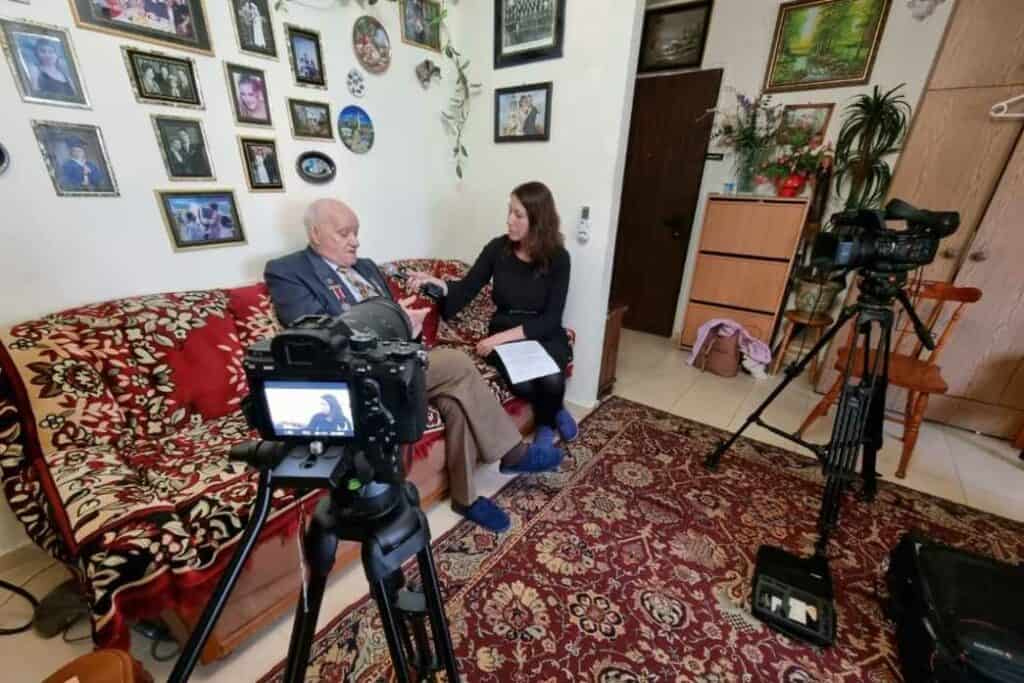
Earlier, an Israeli man who is thought to be the last survivor of Babyn Yar, Michael Sidko, spoke by video link to delegates of the European Jewish Association symposium in Kiev’s Hilton.
Mr Sidko was six years old when a neighbour reported his family to the Gestapo three times as being Jewish, and they were arrested and brought to Babyn Yar.
The family were directed to “the pit” where Nazi officers supervised the killings.
As his mother held her baby son Volodya in her arms, his three-year-old sister Clara walked beside tugging at her skirt, and he and his older brother Grisha brought up the rear.
Clara ran up to Mr Sidko, he said, and asked to be carried in his arms. A policeman hit the girl in the head, knocking her to the ground.
He stamped on her chest until she stopped breathing. Mr Sidko’s mother saw this and fainted, dropping Volodya.
The policeman stamped on Volodya until he was dead.
Mr Sidko’s mother came round and screamed. She was shot, and all three bodes were hauled by the legs thrown into the pit.
The two brothers were selected for medical testing or forced labour and so permitted to live, Mr Sidko said, before a Russian or Ukrainian guard allowed them to run away.
“Hitler’s greatest mistake was making Auschwitz,” said Father Patrick of the Babyn Yar Holocaust Memorial Center, because the camp became evidence of Nazi crimes against humanity.
But at Babyn Yar there was “no train, no railway, just a mass grave”.
Mr Sidko long refused to talk about the massacre or even mention his Jewish identity to even his own children.
It was only in 2000 that he told his children they were Jewish and the family made aliyah.
“People should study history,” he added.“Students should be taught to love not hate.”
https://www.thejc.com/news/world/last-survivor-of-massacre-reveals-the-horror-of-babyn-yar-rHBFu0qobRGTTFoyk3GRm
Additional Articles

EUROPEAN JEWISH ASSOCIATION CONGRATULATES VIKTOR ORBAN ON REELECTION

“You have been a stalwart defender of Israel on the world stage, recently going against the prevailing EU winds and supporting the move to recognise Jerusalem as the capital of Israel…As long as you continue to show the right way ahead when it comes to defending and upholding Jewish rights, you will continue to enjoy our support”, says EJA Chairman Rabbi Margolin
European Jewish Association has written to Hungarian Prime Minister Viktor Orban to congratulate him on his reelection, and to seek assurances that he will continue to defend and uphold Hungarian Jewry under his new mandate, as well as continue his vocal support, diplomatic and political support for the State of Israel.
In his letter to Hungary’s Premier, EJA Chairman and founder Rabbi Menachem Margolin wrote,
‘You have been a stalwart defender of Israel on the world stage, recently going against the prevailing EU winds and supporting the move to recognise Jerusalem as the capital of Israel. As European Jewry and the State of Israel are inextricably linked, your support for the Jewish State means a lot to us and we thank you for it.
“During your previous term in office your steadfast assurances and commitments to protect Hungarian Jewry and their heritage were warmly welcomed and were an anchor to us in these turbulent political times.
“With great power comes great responsibility – so the saying goes. We earnestly trust that your previous positive and embracing stance to your Jewish citizens will be carried over into your new term and across your government.
“Europe stands at a crossroads. As long as you continue to show the right way ahead when it comes to defending and upholding Jewish rights and standing up for the State of Israel you will continue to enjoy our support.”

Protesters mass in France, Israel, UK to demand justice for Sarah Halimi

In France, some 25,000 demonstrate against court decision that Jewish woman’s killer was too stoned to be held criminally responsible
Protesters gathered in Paris, Tel Aviv, Jerusalem, and London on Sunday to demonstrate against the ruling of France’s highest court that the killer of a Jewish woman in the French capital was not criminally responsible because he had smoked marijuana before the crime.
Sarah Halimi, a 65-year-old Orthodox Jewish woman, was pushed out of the window of her Paris flat to her death in 2017 by neighbor Kobili Traore, who shouted “Allahu Akbar” (“God is great” in Arabic).
But in a decision earlier this month, the Court of Cassation’s Supreme Court of Appeals upheld rulings by lower tribunals that Traore cannot stand trial because he was too high on marijuana to be criminally responsible for his actions.
Some 25,000 protesters, many of them Jewish, gathered in Paris to demand justice for Halimi.
Under the banner of “Justice for Sarah Halimi,” the rally at Trocadero Square overlooking the Eiffel Tower reflected the widespread indignation of many French Jews at the April 14 ruling by their country’s highest court.
It was held under tight security arrangements in a cordoned-off enclosure where the Jewish umbrella group CRIF played a video on a giant screen in which French Chief Rabbi Haim Korsia demanded another “trial of facts,” even if it ends without sentencing of Traore.
The rally Sunday was the first time in decades that a large number of French Jews gathered to protest against organs or actions of the French state.
“The clamor has risen and hope has returned. That hope is all of you here,” Halimi’s brother William Attal told a crowd of several thousand at the Trocadero esplanade in Paris.
The MP who leads Macron’s Republic on the Move party, Christophe Castaner, addressed the protest, which was also attended by opposition leaders and by several well-known actors.
Jacques Essebag, a French-Jewish comedian who is known by the stage name Arthur, in a video message said he has “decided to start using drugs because in France you can do whatever you want, even kill your neighbor if you don’t like her, if you use drugs.” He then added: “What has become of this country?”
Former French first lady Carla Bruni, wife of Nicolas Sarkozy, also appeared at the Paris rally, as did Mayor Anne Hidalgo, who said the city would soon name a street in Halimi’s memory.
“It will also be a way of doing her justice,” Hidalgo said.
However, the video message from Hidalgo, a Socialist politician, provoked whistles and booing from many protesters at the event, which did not feature live speeches due to COVID-19 measures.
Organized by the CRIF umbrella of French Jewish communities, the rally was called “to show our astonishment at a decision that conforms to the law, but not to justice,” CRIF said.
The event featured many French and Israeli flags, and those of the far-right Jewish Defense League.
More than 20,000 people demonstrated in Paris, and up to 2,000 took part in a march in the Mediterranean city of Marseille, police said, while around 600 gathered outside a synagogue in the eastern city of Strasbourg.
Three protests were also held in Israel, all taking place at 3 p.m. in order to coincide with the demonstration by the Jewish community in Paris. The main demonstration was in front of the French Embassy on Herbert Samuel Street in Tel Aviv.
The Jewish community in the United Kingdom also demonstrated in front of the French Embassy in London on Sunday at 1 p.m., in solidarity with the community in France. Attendance was limited because of COVID-19 restrictions.
In addition to the rally in Paris, protest rallies were planned to take place on Sunday in Marseille, Strasbourg and Lyon. Abroad, rallies were scheduled to be held in Washington, DC, Los Angeles and Miami in the United States as well as in Rome, Italy.
Some Jewish organizations have used harsh language about the case, including the conservative Europe-Israel group, which called it “the new Dreyfus Trial.” It’s a reference to the anti-Semitic treason charges leveled at a French-Jewish soldier in 1894, and which many to this day believe showed that French society and European societies, in general, were too anti-Semitic to allow Jews to truly integrate.
Israel blasted the decision of the French court last week.
“Sarah Halimi was murdered for clearly anti-Semitic motivations, for the sole reason that she was a Jew,” Foreign Ministry spokesman Lior Hayat told The Times of Israel. “This was a despicable murder that harmed not only the victim herself and her family, but also the entire Jewish community’s sense of security.”
“The way to confront anti-Semitism is through education, zero tolerance, and heavy punishment,” Hayat continued. “This is not the message that the court’s ruling conveys.”
Sarah Halimi was beaten before she was thrown off her Paris apartment building’s roof in April 2017. (Courtesy of the Halimi family)
Critics of the ruling cited apparent composure by Traore, an immigrant from Mali who was 27 when he killed Halimi, a physician in her 60s. Traore, whom a lower court said targeted Halimi because she was Jewish, called her a demon as he pummeled her in her third-story apartment, which he entered by force.
He then threw her out the window and shouted: “A lady fell down from the window!” to cover up his actions, witnesses said. He left the scene, allegedly to escape it, and was arrested on a nearby street.
Others argue that even if Traore was psychotic, he was criminally liable when he took the drugs that made him psychotic and should therefore stand trial. He has no documented history of psychiatric problems.
French President Emmanuel Macron has said he would advance legislation to prevent criminals from avoiding trial by using an insanity defense for actions committed under the influence of drugs.
Read more

Ways to help the Jews of Ukraine

In response to the Russian invasion of Ukraine, Jewish organizations are directing aid for tens of thousands of Jews living in the embattled country, assisting refugees who are fleeing the fighting and helping area Jews who have been trying or are hoping to immigrate to Israel.

Below is a partial list of organizations that have ramped up ongoing efforts in the region or opened emergency mailboxes since the start of the war.

• The Jewish Federations of North America has an emergency mailbox for helping people immigrate to Israel, securing the local Ukrainian community and its institutions and maintaining critical welfare services, among other needs.

• The American Jewish Joint Distribution Committee has a longstanding presence in the country, assisting impoverished seniors and supporting a network of Jewish community centers and social service agencies.

• The American Jewish Committee’s emergency #StandWithUkraine fund is pledging to direct 100 percent of the funds to those meeting urgent needs in Ukraine, including  IsraAID, the rapid response Israeli relief agency, which is assisting refugees of all backgrounds in neighboring Moldova.

• HIAS is  working through channels within the US and throughout Europe to support the safe and speedy resettlement of those seeking to leave Ukraine.

• The Jewish Agency for Israel has opened an emergency hotline to provide Ukrainian Jews with guidance and information regarding the immigration process, as well as general assistance.

• The Chabad-Lubavitch movement has a Ukraine Jewish Relief Fund.

• Masorti Olami has a fund for Ukrainian Relief.

• UJA-Federation of New York has a dedicated mailbox supporting its partners providing humanitarian needs in Ukraine.

• Project Kesher is currently supporting an Emergency Fund for Women in Ukraine.

• Agudath Israel has a Ukraine Emergency Relief fund that has raised $10 million as of March 10.

• United Hatzalah of Israel has sent medical professionals to Ukraine’s borders in Operation Orange Wings. Donations to their fund help deliver medical care to Ukraine.

• JRoots runs heritage trips to Poland to tell the story of the Holocaust. Since Russia’s invasion of Ukraine, it has repurposed to assist Ukrainian refugees into Poland and settle abroad. Contact Ayelet at +972 54-636-6512

• First-responder group IsraAID is on the scene as thousands of Ukrainians seek refuge in Moldova. IsraAID is providing psychological first aid and distributing essential relief supplies. Donations towards emergency support for Ukrainian refugees can be made here.

• Magen David Adom, Israel’s branch of Red Cross International, has established a Russian-language  refugee call center. Donations can be made here.

• Hadassah, The Women’s Zionist Organization of America has opened a fund, “Ukraine in Crisis: Save Lives at Risk!” in support of the Hadassah Medical Organization, which is already treating Ukrainian refugees at its centers in Israel.

• The Brussels-based European Jewish Association (EJA), representing hundreds of communities across the continent, has launched a Europe-wide campaign to temporarily provide homes, food and clothing to hundreds of Jewish families whose lives have been torn-apart and up-ended by the conflict in Ukraine. For further information contact: +32 (0)476056450

• The Orthodox Union has opened a Ukraine Crisis Fund to support individuals and organizations assisting people on the ground in Ukraine.

• World Jewish Relief has been working in Ukraine for the last 30 years, and has helped 13,000 older and more vulnerable Ukrainians within and beyond the Jewish community in the past year alone. Its Ukraine Crisis Appeal is raising funds to support the organization’s 29 partners in Ukraine, along with partners in neighboring Moldova and Poland, which are providing food, cash, medical, material and psychological support to those fleeing or unable to escape the violence.

• The World Union for Progressive Judaism has launched the Ukraine Crisis Fund to support the safety and well-being of the Ukrainian Jewish community.

• Keren Hayesod – United Israel Appeal is working with the Jewish Agency and the Israeli government to expedite immigration to Israel for Ukrainian Jews, as well as assist the Jewish community remaining in Ukraine with essential goods such as food, supplies, security and other necessities.

Top European Jewish group calls upon governments to urgently declare a formal state of emergency on antisemitism

Call comes from Auschwitz, where European Jewish Association (EJA) is leading a delegation of politicians, mayors and university deans to the death camp and a symposium on combating antisemitism.

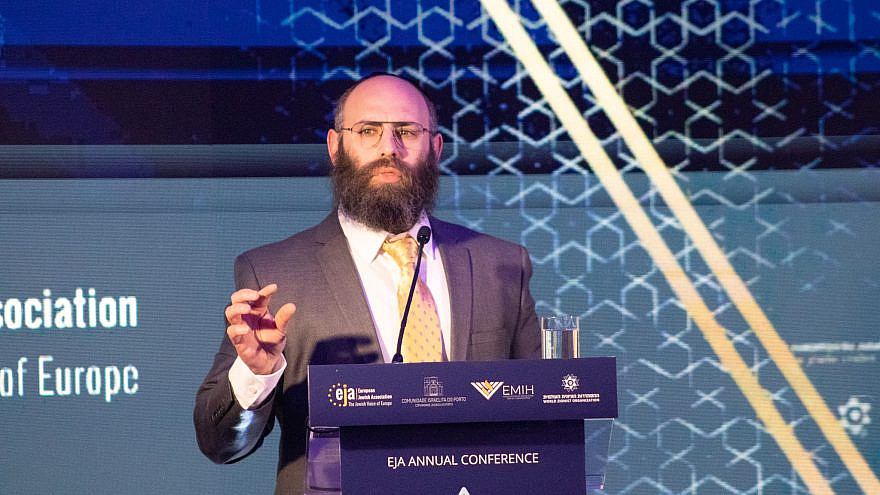
Krakow, Poland, November 19, 2024 — At the European Jewish Association (EJA) annual conference and symposium marking the remembrance of Kristallnacht, EJA Chairman, Rabbi Menachem Margolin, issued a powerful call to European governments to declare an urgent six-month emergency period to address the alarming rise in antisemitism.

Gathering politicians, mayors, university leaders, and experts, the symposium tackled the dual challenge of rising antisemitism and Holocaust denial in European universities and education systems. Discussions ranged from the conflation of anti-Zionism with antisemitism to the safety of Jewish communities and students. The emotional resonance of being at Auschwitz underscored the urgency of Rabbi Margolin’s call to action:

Reflecting the sense of crisis, EJA Chairman Rabbi Menachem Margolin, in his opening remarks, called on European Governments to declare an urgent six month antisemitism emergency period with much tougher laws on hate speech and incitement, regulated public events/protests, and increased security provision for Jewish areas.

Rabbi Margolin said, “I am very aware that Six million murdered Jews would be horrified that while Europe’s Politicians say “Never Again”, Europe is, in fact, heading down the darkest path, again. We have already long passed the stage of warnings and prophecies. Today, Jews are openly attacked in the streets with impunity. The perpetrators are given the lightest of sentences, if at all. Freedom of speech is being abused daily to incite murder, hate and division. It is directly fueling the fire of antisemitism.” The European Jewish Association is today urging the European Union and its member states to declare an immediate six-month period of emergency on antisemitism. This period would entail a heightened level of protection for Jewish communities across Europe, reflecting the nature of the emergency. This protection includes the enactment of special security measures: Such as ensuring that there is proper and meaningful regulation of public events, including the banning and penalizing of expressions that are antisemitic in nature and that incite. Emergency designation should also see increased police presence in Jewish areas, the requirement of pre-authorization and an enforceable code for conduct and language at public demonstrations and the appointment of dedicated judicial resources, all of which must meet European legal frameworks. By adopting these enhanced precautions for an initial six month period, we seek not only to safeguard Jewish communities but to uphold core European values. Every Jewish Community on the frontline is awaiting the worst and wondering when a real European Political response will come. Now is the time.”

Discussing the rise of Antisemitism in education across Europe, Professor Christer Mattson, an expert in radicalization, highlighted the critical role education plays in countering prejudice:  “Antisemitism isn’t about Jews; it’s about the fantasies of antisemites. Jews are painted as whatever the antisemite needs—communist, capitalist, colonialist, you name it. This isn’t new; it’s history repeating itself,” he said. “We must teach young people to understand intolerance, or they will grow up speaking the language of hate.”  Professor Mattson’s sentiments were echoed by MP Petros Pappas of Greece, who called for modernized Holocaust education that bridges past atrocities with today’s challenges. “Education must address polarization and foster a sense of shared European identity,” he said.

Another growing concern discussed at the symposium was the hostility faced by Jewish students on European university campuses. Emilie Zerbib, President of the French Union of Jewish Students, shared her experience at Sciences Po:  “Antisemitism was legitimized by public figures hosted by the university. We, as Jewish students, were told we are no longer welcome. It is clear that this is no longer about Israel or politics—it’s about silencing Jewish voices altogether.”

King’s College London student Aurele Tobelem expressed frustration at universities’ failure to protect Jewish students. “It’s appalling that I have to defend the basic right of Zionist students to express their beliefs without fear. If anti-Zionism is a protected belief, then so must Zionism—it is integral to Jewish identity.”

Panelists urged universities to adopt the **International Holocaust Remembrance Alliance (IHRA) definition of antisemitism** to establish clear frameworks for tackling hate speech on campuses.

Budapest Mayor Gergely Karácsony reflected on the lessons of history and the importance of standing against hatred:  “The opposite of love is not hate—it is indifference. And indifference cannot be allowed to take root in Europe. The best answer to antisemitism is building inclusive societies where hatred has no place.”

German MP Frank Müller-Rosentritt called for more intensive Holocaust education, including mandatory visits to concentration camps: “Young people must experience the reality of history to challenge their prejudices. Antisemitism is not freedom of speech—it is hate speech.”

The symposium also explored strategies to integrate Jewish culture into the social fabric of European cities. Burkhard Jung, Mayor of Leipzig, shared his city’s approach: “We promote and normalize Jewish life as part of Leipzig’s identity. The fight against antisemitism starts with making Jewish culture a visible and celebrated part of our society.”

Sara Wettergren, Malmo’s Councilor for Education, discussed interfaith initiatives involving rabbis, priests, and imams speaking at schools: “We’ve worked to create safe spaces in schools for all children, especially after the recent surge in hate speech following global events.”

The symposium concluded with a memorial dinner, honoring Holocaust victims and contemporary heroes. Daniel Sharabi, a survivor of the Nova Music Festival massacre, received the King David Award for bravery and said: “We have the right to exist, the right to rebuild, and the right to hope,” he said.

Pastor Dumisani Washington, director of the Institute for Black Solidarity with Israel, received the King Solomon Award for his unwavering support of the Jewish community. In his remarks, he drew a stark parallel between the past and present: “The Islamic Republic of Iran is the Third Reich of today. Zionism is not just a political movement—it is a testament to survival and renewal.”

As the symposium closed, Rabbi Margolin’s final words resonated: “This isn’t just about the Jewish community—it’s about the very soul of Europe. We are past ‘Never Again’; we are in the moment of now. If Europe doesn’t act, history will judge us all.”

For further information please contact: Tamar Nuijen +972-50-372-0304

Additional Communities
United State
United Kingdom
Ukraine
Turkey
Schweiz
Switzerland
Sweden
Spain
Slovenia
Slovakia
Serbia