RELIGIOUS LEADERS PLEAD FOR TOLERANCE IN BELGIUM AMID ISRAEL-GAZA WAR

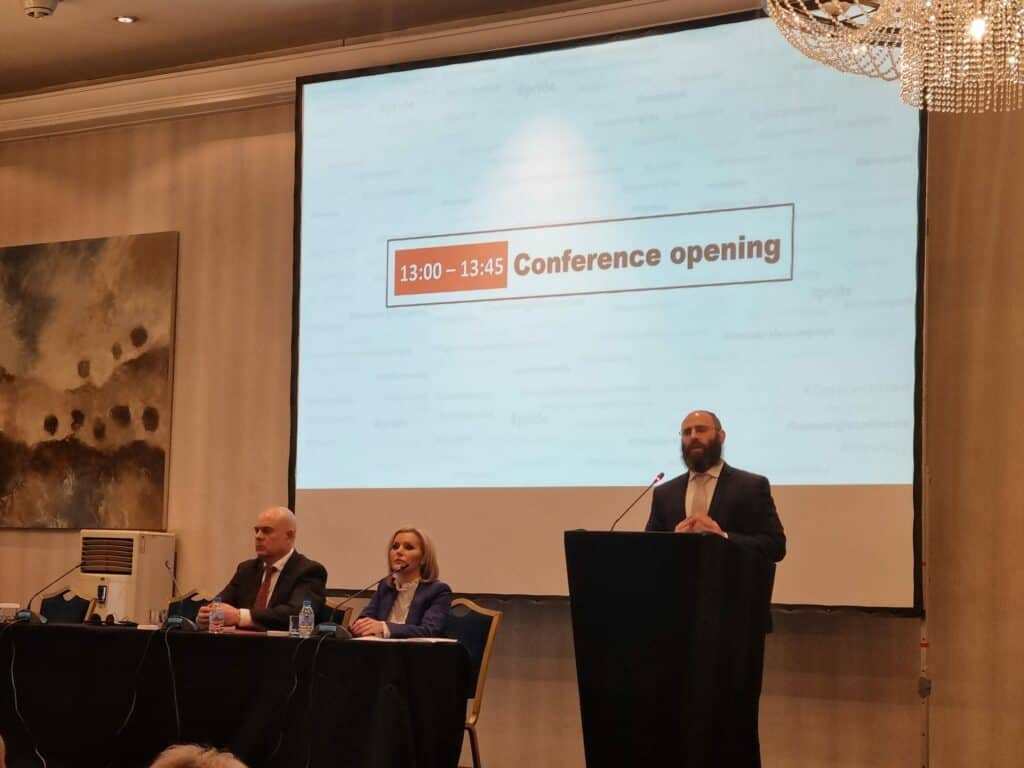
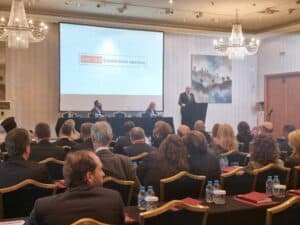
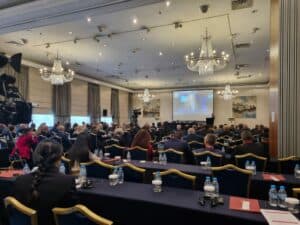
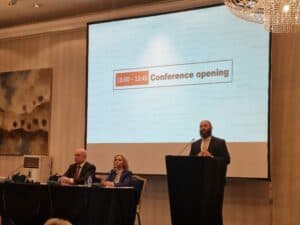
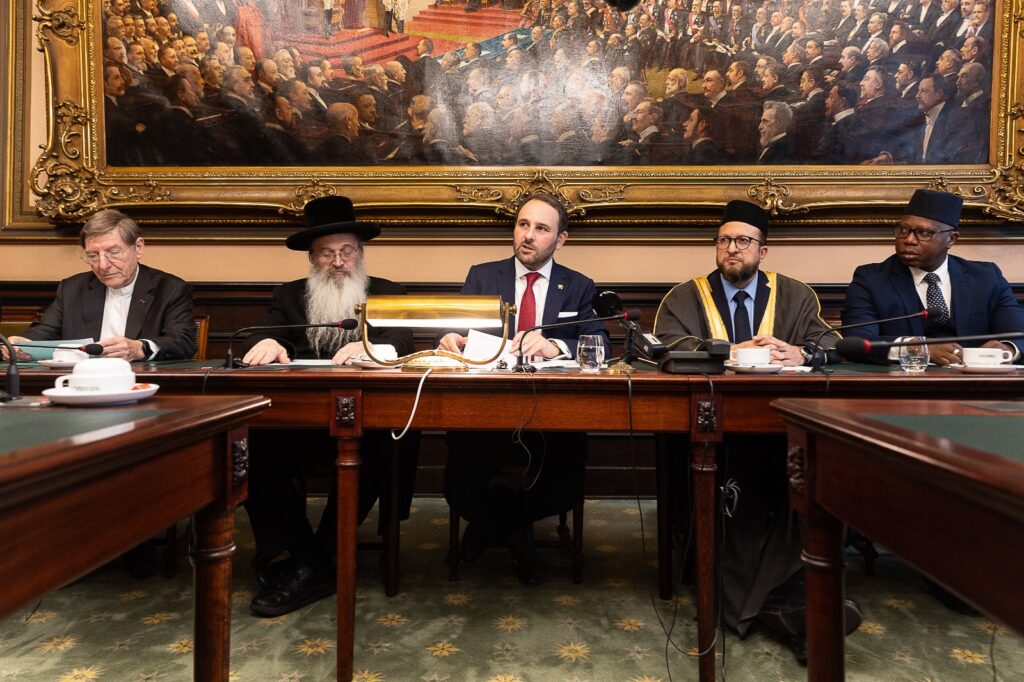
Under the auspices of Belgian MP Michael Freilich, leaders of the 3 major religions came together today in a moment of unity to promote peace and tolerance. (Photos: Michael Freilich/ BELGA)

Jewish MP Michael Freilich: “Given the tensions in our streets, the attack in Brussels, the attack on Jewish targets in Europe and the terrible suffering of war in the Middle East, I decided to take this step and invite Chief Rabbi Pinchas Padwa, Imam Nordine Taouil and priest Rik Hoet to the heart of our democracy, the Parliament in Brussels.”

The press was present in large numbers to attend the reading of a joint statement.

Rabbi Padwa: “We extend a warm call to all people of goodwill in our communities and beyond: Let us join hands, join positive forces and show unity for building a warm society – across our different ideas and beliefs. As this meeting today makes clear, this is absolutely possible.”

Imam Taouil: “There is so much more that unites us than what divides us. Let us not import conflicts from elsewhere and let our lives be guided by extreme ideas and views.
In this country, we are all fellow citizens, neighbours, friends and/or trading partners. Our fragile social fabric, especially in these anxious times, deserves to be nurtured and strengthened. The recent Abraham Accords are an encouraging step in the right direction.

Priest Hoet: “Bringing together different cultures and faiths, sharing joyful moments and building a common future are positive steps that we warmly welcome and encourage.”
Freilich concluded, “Let us strive for peace, warm citizenship and closeness, pause to remember every innocent victim, and resolutely reject and condemn terrorism.”

Rabbi Padwa asked for a moment of prayer, each in their own distinct way, to promote peace.
Additional Articles

Jewish Leaders and UAE Ambassador Hold Minute of Silence in EU Parliament

BRUSSELS, Monday Dec 3, 2024 – Under the auspices of the European Jewish Association (EJA), a solemn moment of silence and the lighting of a memorial candle took place today at the European Parliament in memory of Chabad Rabbi Zvi Kogan, who was brutally murdered in the United Arab Emirates last week.

The tragic incident has sent shockwaves across Jewish and Israeli communities worldwide.

UAE Ambassador Mohammed Am Sahlawi joined the commemoration, offering his heartfelt condolences: “What happened is extremely shocking and very sad. This act of extremism is precisely why we must double down on our shared values of coexistence and tolerance.”

Rabbi Menachem Margolin, Executive Director of the EJA, strongly condemned the attack, stating: “This horrific act of terror is a stark reminder that antisemitism and hatred have no borders. It is incumbent upon all of us to fight these dark forces and to strengthen the bonds of understanding and mutual respect among nations.”

Michael Freilich, the only Jewish lawmaker in Belgium and a special diplomatic envoy for the EJA, also addressed the gathering: “Let’s turn this tragedy into a rallying call for unity and cooperation. The Abraham Accords have shown us what is possible when Jews and Arabs come together as partners in peace. The most powerful message we can send to those who wish to divide us is that they will fail. Our resolve for coexistence and collaboration is unshakable.”

The commemoration serves as a poignant reminder of the importance of continued dialogue and partnership between Jewish and Arab communities. It also underscores the enduring need to combat extremism in all its forms and to build bridges of understanding across the globe.

Diary Reflections on Jewish Identity and Antisemitism in the Netherlands

“I stress time and again that most victims of ISIS are Muslims. And when a topper from our government said to me, when we were discussing anti-Semitism, that in the Netherlands today 98 per cent of anti-Semitism comes from Muslims living in our country, I pointed out to him that when 80 per cent of my family was murdered there was not a single Muslim to be seen in the Netherlands,” I wrote in my diary of 7 February. Let me add that the day after 7 October, I received a phone call from our minister of general affairs, Van Gennip, who asked interestedly how I was doing and told me that “both the Moroccan and Turkish communities in the Netherlands do not find the events of 7 October acceptable”.

Probably I am a little too naive, because as far as I know, no mosque or Islamic community has dared to publicly distance itself from the 7 October massacre. Yes, a number of befriended imams let out a sincere and condemning sound in a personal conversation (I will not mention their names here, to avoid getting into Islamic trouble), but the Islamic silence at the time and the anti-Israel demonstrations at the opening of the Holocaust Museum and the anti-Herzog call by two hundred mosques do not make me feel good and worry for the future of Jewish Holland. Where were those two hundred mosques immediately after October 7? And I dare even ask myself: is there any future for the Jewish community in my homeland?

And the Netherlands is my homeland! Through my father’s line, I am the fourteenth generation after Chief Rabbi Moses Uri Halevi, the founder of the Portuguese-Israelite Congregation in Amsterdam. His congregation made Amsterdam into Amsterdam, put the city on the map and thus made a gigantic contribution to today’s Mokum. This makes it all the more painful to see the anti-Israel demonstrations and the enormously rising anti-Semitism close to the place from which 46 thousand Amsterdam Jews were deported on the trams of the GVB in World War II to end up, via Westerbork, on the trains of our own Dutch Railways, finally via the chimneys of the crematoria in the extermination camps in the dark hole of oblivion.

I dare even ask myself: is there any future for the Jewish community in my homeland?

How was the official opening of the Holocaust Museum? King Willem-Alexander, the president of Israel, the president of Austria and the chairman of the German Bundesrat spoke impressive, well measured words. The music, the speech by my friend Emile Schrijver, director of the Jewish Cultural Quarter, the other speakers, the voices of survivors, the children and the master of ceremonies Petra Katzenstein. If I wanted to properly put into words the impression this unforgettable, historic day made on me, I would read a few lines without words.

Every word I would write would be one too many, because the opening, the ceremony, the togetherness transcended all words. It was a deeply emotional event. Words describe, but words also limit and so: not a word I can dedicate to it.

And yet something also went wrong, wrong. Throughout the happening, anti-Semitic protests were heard. While the speakers were not drowned out, the music remained audible, their roar was like false-sounding background music, which, while not distracting from the perfect programme, demonstrated how necessary the Holocaust Museum is. In my opinion, the emotional damage done to survivors present was not adequately taken into account. And although, thank God, I was born only after the war, I too felt brutalised by the shouting crowd. I cherish freedom of speech, but the bestial manner in which I was shouted at, and with me so all those who came outside the Snoge, I find unacceptable. I do not understand why this was tolerated. The location from where the chanting was carried out was also painful: Waterloo Square, the source of Jewish life in the Jewish quarter at the time!

During the ceremony, fortunately I had my phone set to ‘do not disturb’, as a number of calls had come in from enraged Jewish people who, I later learned, found it unacceptable that protests were allowed and guests were allowed to be booed as they left the Snoge. At the amazing lunch at the Jewish Museum and especially when touring the Holocaust Museum, I was able to provide a lot of pastoral care. Many felt deeply hurt and abandoned … Yet, the feeling of gratitude and joy that this great monument was officially opened prevailed with everyone.

I cherish freedom of speech, but I find the bestial way I was called names unacceptable.

With this afternoon’s anti-Semitic roar still buzzing in my ears, I watched the documentary on the Jewish Council. It won’t be too bad, it was thought at the time. And so the Jewish Council was established. How do we view the growing anti-Semitism in 2024? Will it not be too bad?

But I must stop now to pack my suitcase and then quickly go to bed. Tomorrow at six o’clock the taxi will arrive and I will be on the plane at ten to eight on my way to Oporto for a three-day conference on kashrut. I hope and expect to learn a thing or two there. Keynote speakers from the rabbinical world, experts on kashrut, will give the speeches. I also have to speak, but what and where is not quite known yet. Probably at the unveiling of the monument being unveiled there in memory of the victims of 7 October.

And meanwhile, I float between my bed and the documentary on the Jewish Council, meet the grandsons of Asscher and Cohen, the chairmen, and wonder whether I am alarmist or realist. Cohen’s grandson fights with me against rising anti-Semitism. I don’t feel myself more unsafe than usual, but anti-Semitism is getting closer … am Jisraeel chai!

Een onvergetelijke dag

French Interior Minister asks to step up protection of Jewish community sites

The minister called for’’reinforced vigilance by forces of law and order and a “systematic presence of internal security forces around schools during the arrival and departure of pupils” and at places of worship “during the arrival and departure of worshippers”.French Interior Minister Gérald Darmanin has asked prefects to step up protection measures for the Jewish community, particularly around schools and places of worship, following the events of the last few days in Gaza, French media reporterd.“Given the high level of the terrorist threat that continues to weigh on our country and the tensions in the Middle East, which have increased sharply in recent days (…) I would ask you to immediately reinforce security measures concerning Jewish community sites”, “in particular with regard to schools”, says a note by the minister consulted by Agence France Presse.He also called for’’reinforced vigilance by forces of law and order and a “systematic presence of internal security forces around schools during the arrival and departure of pupils” and at places of worship “during the arrival and departure of worshippers”.Darmanin also called on prefects to mobilize “intelligence services to assess threats to public order” and to pay “particular attention to any forthcoming demonstrations”.

French Interior Minister asks to step up protection of Jewish community sites

FJO Meets Belgian Justice Minister Amidst Escalating Antisemitism Concerns; Former MP Van Langenhove Sentenced to Jail

The FJO held a meeting with Belgian’s minister of Justice Van Tigchelt in regard to the increasingly problematic situation of rising antisemitism. While the dialogue was constructive, with a focus on zero tolerance for antisemitic crimes, it remains to be seen what the future will hold.

Coincidentally, the case has been closed against former member of parliament, Dries Van Langenhove, who investigated, among other things, his sharing of content, denying or minimising the Shoah. He has been sentenced to 1 year in jail.

Additional Communities
United State
United Kingdom
Ukraine
Turkey
Schweiz
Switzerland
Sweden
Spain
Slovenia
Slovakia
Serbia