Bulgarian Synagogue and Halle Memorial Targeted in Anti-Semitic Attacks in Europe

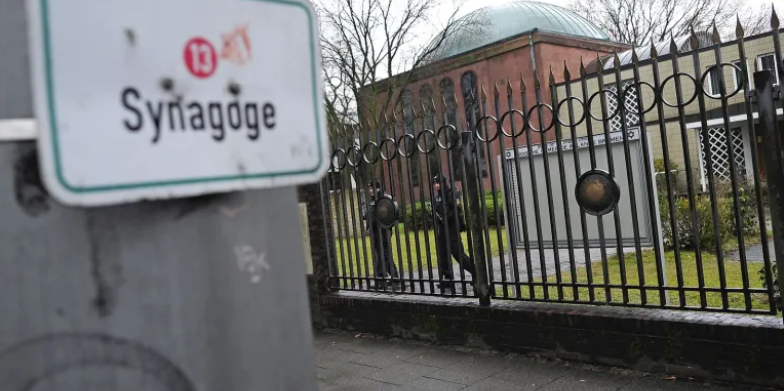
Vandals struck a synagogue gate in Bulgaria and a monument to the victims of the shooting attack last Yom Kippur near a synagogue in Halle, Germany, in a spate of unrelated incidents last week in Europe, the JTA reported.
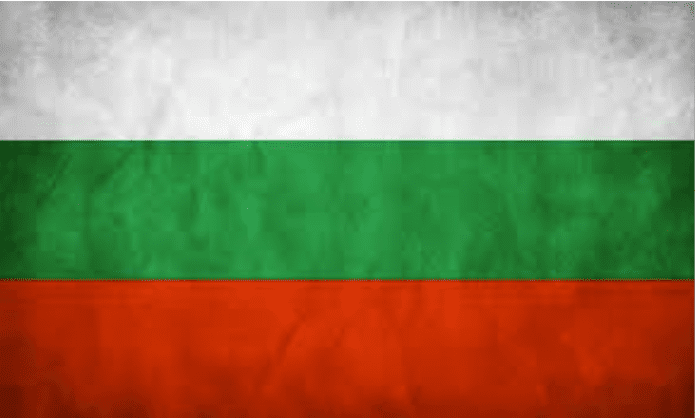
In Bulgaria, the words “Free Palestine Israel=Nazis Antifa Bulgaria” were spray-painted Wednesday on the gate to the synagogue of Plovdiv, a city situated about 100 miles southeast of the capital Sofia.
While in Germany, in Halle, a plexiglas panel on the monument of the shooting was smashed. The vandals also tried to set fire to a flag of Israel under the Plexiglas, the Jewish Community of Halle wrote Tuesday on their social media page.
Also in Germany, in a third incident, a structure inside the Jewish cemetery of the town of Krumbach, in southern Germany, was damaged. Police are treating the vandalism as an anti-Semitic case because earlier this year, a nearby picnic table was dismantled and the wooden polls comprising it rearranged on the floor in the shape of a swastika, the website AllgaeuRechtsaussen reported Monday.
Also Monday, metal thieves removed dozens of fences and railings from around tombstones at the Jewish cemetery of Babruysk in Belarus, the news Bobruisk.ru reported.
Read More
Additional Articles

Far-right going mainstream in Europe

ZAGREB: Hungary’s prime minister declares that the “color” of Europeans should not mix with that of Africans and Arabs. His Polish counterpart claims Jews took part in their own destruction in the Holocaust. And the Croatian president has thanked Argentina for welcoming notorious pro-Nazi war criminals after World War II.Ever since World War II, such views were taboo in Europe, confined to the far-right fringes. Today they are openly expressed by mainstream political leaders in parts of Central and Eastern Europe, part of a global populist surge in the face of globalization and mass migration.
“There is something broader going on in the region which has produced a patriotic, nativist, conservative discourse through which far-right ideas managed to become mainstream,” said Tom Junes, a historian and a
researcher with the Human and Social Studies Foundation in Sofia, Bulgaria.
In many places, the shift to the right has included the rehabilitation of Nazi collaborators, often fighters or groups celebrated as anti-communists or defenders of national liberation. In Hungary and Poland, governments are also eroding the independence of courts and media, leading human rights groups to warn that democracy is threatened in parts of a region that threw off Moscow-backed dictatorships in 1989.
Some analysts say Russia is covertly helping extremist groups in order to destabilize Western liberal democracies. While that claim is difficult to prove with concrete evidence, it is clear that the growth of radical groups has pushed moderate conservative parties to veer to the right to hold onto votes.
That’s the case in Hungary, where Prime Minister Viktor Orban and his Fidesz party – the front-runner in the April 8 elections – have drawn voters with an increasingly strident anti-migrant campaign. Casting himself as the savior of a white Christian Europe being overrun by hordes of Muslims and Africans, Orban has insisted that Hungarians don’t want their “own color, traditions and national culture to be mixed by others.”
Orban, who is friendly with Russian President Vladimir Putin, was also the first European leader to endorse Donald Trump in the 2016 U.S. presidential race. In 2015, he erected razor wire at Hungary’s borders to stop migrants from crossing and has since been warning in apocalyptic terms that the West faces racial and civilizational suicide if the migration continues. Orban has also been obsessed with demonizing the financier and philanthropist George Soros, falsely portraying the Hungarian-born Holocaust survivor as an advocate of uncontrolled immigration into Europe. In what critics denounce as a state-sponsored conspiracy theory with anti-Semitic overtones, the Hungarian government spent $48.5 million on anti-Soros ads in 2017, according to data compiled by investigative news site atlatszo.hu.
In a recent speech, Orban denounced Soros in language that echoed anti-Judaic cliches of the 20th century. He said Hungary’s foes “do not believe in work, but speculate with money; they have no homeland, but feel that the whole world is theirs.”
In nearby Poland, xenophobic language is also on the rise. When nationalists held a large Independence Day march in November, when some carried banners calling for a “White Europe” and “Clean Blood,” the interior minister called it a “beautiful sight.” Poland’s government has also been embroiled in a bitter dispute with Israel and Jewish organizations over a law that would criminalize blaming Poland for Germany’s Holocaust crimes.
With tensions running high in February, Prime Minister Mateusz Morawiecki listed “Jewish perpetrators” as among those who were responsible for the Holocaust. He also visited the Munich grave of an underground Polish resistance group that had collaborated with the Nazis.
In the same vein, an official tapped to create a major new history museum has condemned the postwar tribunals in Nuremberg, Germany, where top Nazis were judged, as “the greatest judicial farce in the history of Europe.” Arkadiusz Karbowiak said the Nuremberg trials were only “possible because of the serious role of Jews” in their organization and called them “the place where the official religion of the Holocaust was created.”
Across the region, Muslims, Roma, Jews and other minorities have expressed anxiety about the future. But nationalists insist they aren’t promoting hate. They claim they’re defending their national sovereignty and Christian way of life against globalization and the large-scale influx of migrants who don’t assimilate.
The Balkans, bloodied by ethnic warfare in the 1990s, are also seeing a rise of nationalism, particularly in Serbia and Croatia. Political analysts there believe Russian propaganda is spurring old ethnic resentments.
Croatia has steadily drifted to the right since joining the EU in 2013. Some officials there have denied the Holocaust or reappraised Croatia’s ultranationalist, pro-Nazi Ustasha regime, which killed tens of thousands of Jews, Serbs, Roma and anti-fascist Croats in wartime prison camps. In a recent visit to Argentina, President Kolinda Grabar-Kitarovic thanked the country for providing postwar refuge to Croats who had belonged to the Ustasha regime.
The world’s top Nazi hunter, Efraim Zuroff of the Wiesenthal center, called her statement “a horrific insult to victims.” Grabar-Kitarovic later said she had not meant to glorify a totalitarian regime.
In Bulgaria, which holds the EU’s rotating presidency, the government includes a far-right alliance, the United Patriots, whose members have given Nazi salutes and slurred minorities. Deputy Prime Minister Valeri Simeonov has called Roma “ferocious humanoids” whose women “have the instincts of street dogs.”
Junes, the Sofia-based researcher, said that even though hate crimes are on the rise in Bulgaria, the problem has raised little concern in the West because the country keeps its public debt in check and is not challenging the fundamental Western consensus, unlike Poland and Hungary.
While populist and far-right groups are also growing in parts of Western Europe, countries like Poland and Hungary are proving more vulnerable
to the same challenges, said Peter Kreko, director of Political Capital Institute, a Budapest-based think tank.
“In younger, weaker, more fragile democracies,” he said, “right-wing populism is more dangerous because it can weaken and even demolish the democratic institutions.”
The article was published on The Daily Star

Rockets fired from Gaza at Jerusalem and the Southern of Israel

The EJA sends our abiding support to the citizens of Israel, assailed by rocket fire from Gaza, and orchestrated riots in Jerusalem. Nobody in Israel wants violence, but Hamas and the Palestinian Authority sadly do not share that view and are ratcheting up violence and tension. We stand for Israel. We stand fir Peace. We stand for an end to this folly.

Iran's Nuclear Acceleration and Regional Threats Discussed at Paris Briefing

It is the end of June 2024, and Iran doesn’t have any nuclear weapons,” Héloïse Fayet, specialist in nuclear and proliferation issues, began her presentation yesterday at a briefing in #Paris organized by the French think tank Fondation Jean-Jaurès in partnership with #EIPA.
 
However, Iran has significantly accelerated its nuclear program, as stated in the latest report from the International Atomic Energy Agency (IAEA). This, along with Iran’s direct attack on Israel in April and the attacks of the regime’s militias in the #MiddleEast, prompted the invitation of two prominent specialists to the briefing specifically on #Iran‘s ballistic and nuclear proliferation and the risk of a military escalation.
 
Héloïse Fayet, head of the Deterrence and Proliferation research program at Ifri – Institut français des relations internationales (French Institute of International Relations), provided insights into Iran’s ballistic missile and nuclear weapons programs. Kasra Aarabi, Research Director on the Islamic Revolutionary Guard Corps at United Against Nuclear Iran (UANI), who came to Paris specifically for the occasion, discussed Iran’s alliance with #Russia, the Iranian regime’s pursuit of nuclear weapons, and the potential escalation in the next eight months before the #American elections. He highlighted the threat the Iranian regime poses, not only as an existential danger to Israel but also as a significant threat to Europe and its Jewish population.
 
—————————————————————————-
 
The European Jewish Association is a prominent and influential organisation dedicated to representing, advocating for, and fostering the interests of the Jewish community across Europe. Founded on unity, tolerance, and inclusivity principles, the EJA bridges diverse Jewish communities and European societies.
 
#BringThemHomeNow #NeverAgainIsNow #NotOnMyWatch
 
Linkedin: @european-jewish-association
Instagram: @ejassociation
Facebook: @ejassociation
X: @EJAssociation

Chief Rabbi Jacobs honours Armenian Genocide victims at dutch service

Why am I present at this commemoration? What does it matter whether or not the murder of innocent people more than 100 years ago is called or recognized as genocide? To answer that question, I self mirrored and questioned myself: How would I react if the existence of the Holocaust was denied or reduced to something small-scale? I would find this unacceptable.
I would consider that a painful and blatant insult to those who were murdered then and to the relatives of today. Recognition is important, as it somewhat relieves the pain of the gaping open traumatic wound.
But, even more importantly: no present without a past. Our youth must know the history and what happened in the past to avoid it from happening again. And could it happen again? I don’t doubt that for a second.
But how could it happen? Were the killers all by definition just evil people? I do not think so. During the Holocaust in Holland the number of people that collaborated with the Nazi’s was only a small percentage. But also, the number of people who resisted and dared to fight evil was miniscule. As the famous historian Prof. Jacques Presser put it in his masterly work Ondergang: “5% were very good and hid Jews, 5% were very bad and sold Jews for Fl.7.50 and 90% turned their head”. The vast majority witnessed and saw it happen, chose the easiest way, even if that road led to the most degrading acts. Whether we talk about the Holocaust, other massacres in our modern history, or about the genocide on Arameans: it has everything to do with the pinnacle of intolerance and looking away.
Could the genocide of then happen again today? Do we learn from history? In my opinion, the only historical law that we can establish with certainty is that people never learn from the past.
Freedom of religion? Yes! Freedom of speech? Yes!
But if freedom of religion is unlimited and calls for the elimination of fellow human beings who think differently or who are different, then that religion or ideology must be strictly banned. And if freedom of expression implies that fellow human beings may be insulted and humiliated to the bone, then we as a society may not accept that, whether it takes place in the Netherlands or anywhere in the world. Extremist ideas are perilous, especially in a climate that is increasingly polarizing globally. And therefore, we as a society must refuse to bury our heads in the sand, have an eye for reality, learn from what happened in 1915. We must point out and teach our youth the dangers of polarization, racial hatred, intolerance, megalomania and genocide.
But is that the purpose of our meeting tonight? Is this meeting an educational project? Are we gathered here primarily to take a lesson from the past and translate it into the present? No!
This meeting started with a minute of silence. Remembering the victims. Men, women and children who were brutally murdered because others believed they should not exist. And I, as a Jew, I’am here to share with you that one minute of silence. I stand next to you, literally and figuratively. I am with you in solidarity!
Speech Binyomin Jacobs, chief rabbi, June 15th 2021, Enschede NL

Additional Communities
United State
United Kingdom
Ukraine
Turkey
Schweiz
Switzerland
Sweden
Spain
Slovenia
Slovakia
Serbia