¿Qué sucede con los judíos que permanecen en Ucrania durante la invasión rusa?

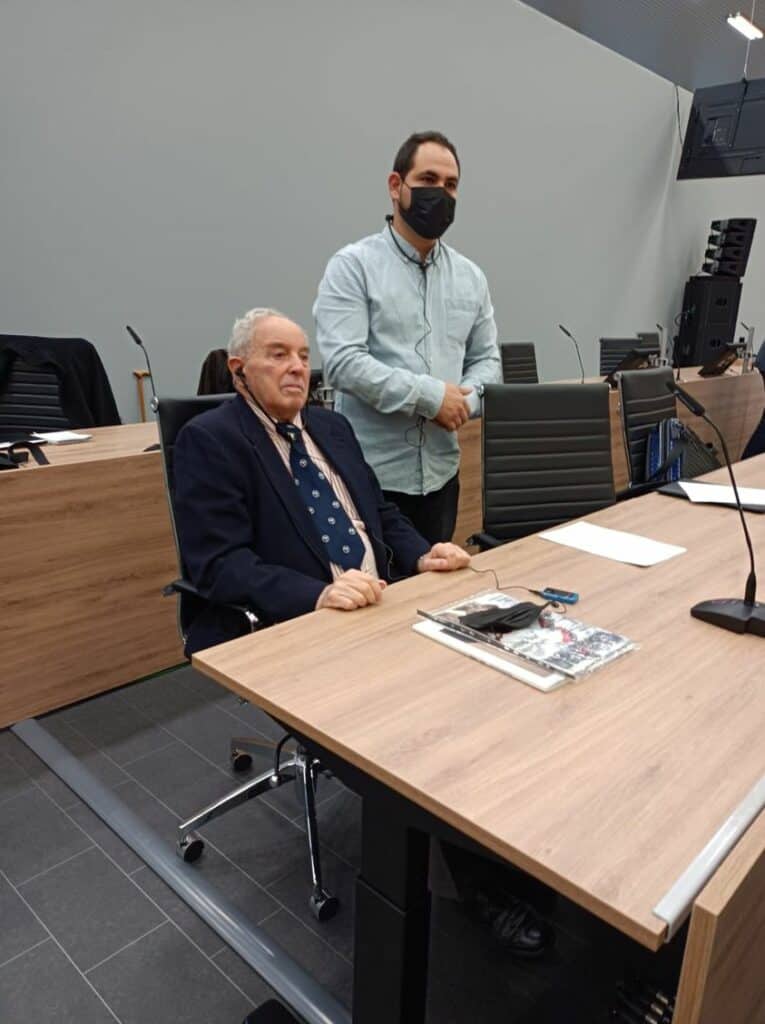
BUDAPEST – Algunos judíos se quedan en Ucrania porque no quieren dejar atrás a sus familiares fallecidos, sin saber lo que les depara el futuro, dijo el martes Aliza, una refugiada de la ciudad de Mariupol, en la conferencia anual de la Asociación Judía Europea (EJA) en Budapest.

Casi 5 millones de ucranianos han sido desplazados desde el comienzo de la invasión rusa de Ucrania el 24 de febrero, según las últimas estimaciones de las Naciones Unidas. Actualmente, según las estadísticas de la Agencia Judía, unos 200.000 judíos siguen allí.

Additional Articles

Yaakov's Bar Mitzvah

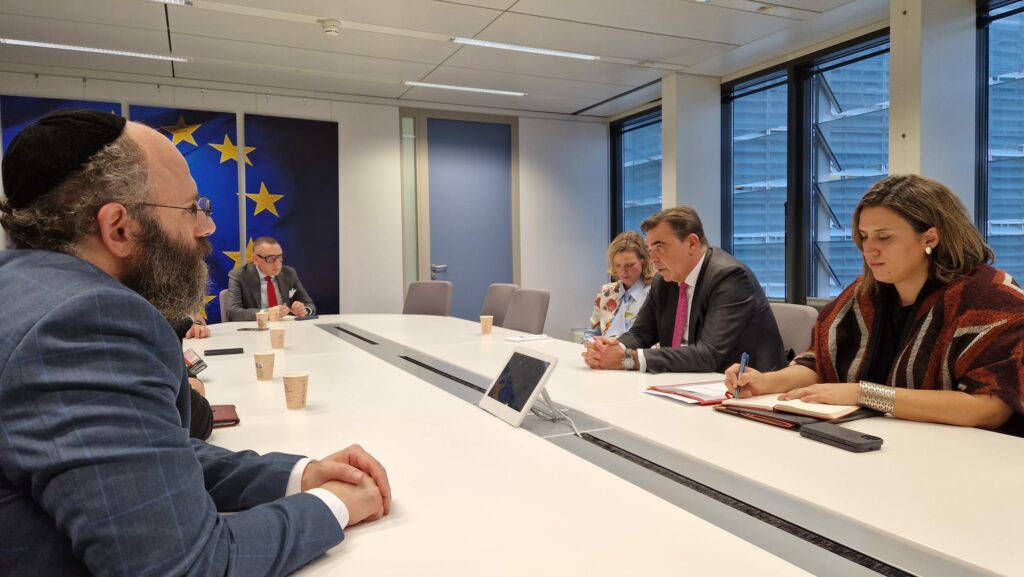
EJA Chairman, Rabbi Menachem Margolin, and his wife Chana have the honour of celebrating the Bar Mitzvah of their son Yaakov on Sunday 29 September at 17:00.

Bar Mitzvah is one of the most foundamental and special celebrations in Jewish life. It is celebrated when a boy turns 13 and it is one of the most important turning points since it is the day of acceptance of all the awesome responsibilities of Jewish life.

It is an opportunity to celebrate together a significant Jewish milestone and learn about one of the principal events in Jewish culture. During the current difficult and dark times when anti-Semitism is on the rise, it is undoubtedly important to celebrate a meaningful and happy event with all our distinguished guests.

Concertgebouw to cancel concerts of Israeli group for demonstration

AMSTERDAM – The Royal Concertgebouw in Amsterdam has announced the cancellation of two performances by the Israeli music ensemble, Jerusalem Quartet. This decision comes amidst concerns over potential demonstrations and recent events surrounding protests in Amsterdam. The Concertgebouw cites a commitment to ensuring the safety of all involved, including employees, visitors, and musicians.

The scheduled concerts, featuring compositions by Felix Mendelssohn, Claude Debussy, and Israeli composer Paul Ben-Haim, were slated for Thursday and Saturday. Comprising three violinists and a cellist, the string quartet has faced disruptions in the past. In February of this year, a performance at the Diligentia theatre in The Hague was disrupted by pro-Palestinian activists who vocally protested and displayed Palestinian flags. Similar incidents occurred previously, including one at the Muziekgebouw aan ’t IJ in Amsterdam.

Critics, particularly anti-Israel organisations, argue that the quartet’s performances serve to polish Israel’s reputation while diverting attention from the situation in the Palestinian territories. The Central Jewish Consultation (CJO) expressed astonishment and disappointment at the Concertgebouw’s decision, accusing them of succumbing to “cancel culture” and urging them to reconsider their stance.

Article: https://www.telegraaf.nl/nieuws/1962229991/concertgebouw-schrapt-concerten-israelische-groep-om-demonstratie

European Jews Demand Unprecedented Scrutiny of Arrests Amid Rising Anti-Semitic Incitement

Amid the dramatic rise in levels of anti-Semitism and anti-Zionism and violent demonstrations on campuses across Europe, encountering a lack of action by European governments or even a tacit encouragement in cases like Belgium and Spain, the European Jewish Association (EJA), representing hundreds of communities across the continent, established a forum of senior lawyers and Jewish jurists from across the continent to develop legal tools to enhance enforcement against manifestations of anti-Semitism.

The lawyers surveyed the legal tools – laws and enforcement mechanisms existing in each country – and discussed current challenges, such as the lack of knowledge among plaintiffs and police, legal loopholes, the sluggishness of the judicial system, and also addressed the distorted reception of the International Criminal Court in the case of the aggression between Hamas leaders who instigated the terrible massacre of October 7 and the Prime Minister and Defense Minister of the attacked state.

The forum decided on a series of operative steps, including calling for examining arrests until the completion of proceedings against inciters against Jews and Israelis in order to create deterrence, legislative processes to define the personal responsibility of politicians and government officials to prevent incitement and hate speech, measures to expedite and accelerate legal proceedings against anti-Semitic attacks, and of course, legal action against anti-Semitism and anti-Zionism.

The Chairman of the European Jewish Association, Rabbi Menachem Margolin, who initiated the forum, noted that: “Unfortunately, too many governments across Europe are not truly willing to combat the plague of anti-Semitism that has reached unprecedented levels since October 7. The ‘National Plans to Combat Anti-Semitism’ and the IHRA definitions are a good tools, but as long as they are not implemented, they remain merely declarative. The plans are shelved and reality is worsening and becoming more dangerous day by day. It begins with people being afraid or hesitant to file complaints against anti-Semitic attackers, continues with the lack of response and the absence of an effective response from law enforcement authorities, and strengthens in the face of the fact that even when an offender is brought to court, the process takes years and in the case of punishment – there is no longer an effective message for deterrence and prevention. If governments, law enforcement authorities, and university officials fail or refuse to address the challenge, then Jewish lawyers will do so. We intend to confront anti-Semitism directly, develop evidence-based legal tools, and disseminate an operative guide that will define to the police what constitutes anti-Semitic incidents and how they should act in each such case. Rabbi Margolin noted that all Jewish lawyers who are members of the forum volunteer fully and out of deep commitment.”

Adv. Pascal Markovitz, European Jewish Association Advisory Board Member and Lawyer at the Paris Bar, a pioneer in the legal fight against anti-Semitic phenomena in Europe, noted that in France, effective legislation has been developed against anti-Semitism and BDS, and the country has also adopted the IHRA definition of anti-Semitism. However, Markovitz noted that there is significant difficulty in enforcing the laws and imposing sanctions on anti-Semites.

Adv. Avram Ishai Head of the Legal Center for Combatting Antisemitism – The International Association of Jewish Lawyers and Jurists (IJLL), which partnered in convening the forum, noted that in Germany too, there is appropriate legislation against anti-Semitism, but the problem lies in enforcement when police lack the tools to identify and address incidents of anti-Semitism.

Wester Meijdam, Policy Officer at the Office of the European Commission Coordinator on combatting Antisemitism, revealed to the lawyers that 71% of Jews in Europe refrain from wearing or wearing items that could identify them as Jews. About 38% of European Jews have considered or are considering emigrating because they do not feel safe in their countries. 9 out of 10 Jews believe that anti-Semitism in their country has worsened.

Adv. Jonathan Turner, Chief Executive, UK Lawyers for Israel, noted that the police in Britain are ignoring the Jewish community – especially in London. While some police officers are very good and deserving, unfortunately, it seems that police commanders are reluctant to deal with the problem of anti-Semitism directly and comprehensively and fear internal rebellion, as a significant number of the officers under their command are Muslims.

The legal advisor to the European Jewish Association, EJA, Adv. Shlomo Dahan, noted that the guide to be developed for enforcement agencies will clarify to officers in the field how to identify and act from the moment a complaint is received to bringing the suspects to justice. The guide will detail to prosecutors in each country the legal channels they must take to achieve justice and how to distinguish when an utterance or act is an anti-Semitic statement or incitement, defined as a crime according to European Union guidelines.


Coronavirus heavily impacts French Jewish community, ZAKA buries victims

Rabbi Menachem Mendel Peretz, head of ZAKA France, alerted the Jewish community, saying that “We are counting bodies, and you are still debating the quarantine measures” 

As of Wednesday night, France reported that 11,539 people were hospitalized after testing positive for coronavirus and 1,331 people  died from the virus, including some Jewish people.

On social media, including many Facebook groups, a list of French Jews infected with the coronavirus was published and is being updated almost daily, people urging the community to pray and read tehillim for them.

In a recent statement, ZAKA claimed that many victims from the coronavirus in France are Jewish and that the organization’s volunteers are burring Jewish victims every day. Rabbi Menachem Mendel Peretz, head of ZAKA France, alerted the Jewish community, saying that “we are counting bodies, and you are still debating the quarantine measures.”
“We are in difficult times, we have a very hard job as we take care every day of the Jews who died as a result of the virus,” he added. “It is very difficult to describe the situation with what we face here every day.”
Rabbi Peretz said that important Rabbis from the community are among the victims.
“Last Saturday, Rabbi Touboul, head of the Beit Hanna and Chaya Mushka schools in Paris, some of the largest Chabad schools for girls in Europe, died suddenly,” he said.
“We worked to fulfill Rabbi Touboul’s will to be buried in Israel. We were able to reach an agreement with the Israeli Ministry of Health, we received very strict instructions on how to treat the deceased according to Jewish law and the Health Ministry guidelines in order to bury him in Israel.”
Rabbi Touboul was buried on Tuesday at the Mount of Olives Cemetery in Jerusalem.
ZAKA’s French head also added that tonight, a French aircraft will land at Ben Gurion Airport, carrying three coffins with the bodies of Jews who died in France from the coronavirus to be buried in Israel.
Among them will be Rabbi Hamou, a major rabbi and community leader of the Mekor Chaim community in Paris, who fought for his life for about a week in the hospital.
In the statement ZAKA begs the Jewish community in France, in Israel, and around the world, to stay home.
“Please, for your own benefit and for your families, apply the Ministry of Health guidelines to stay home, to stay alive,”  ZAKA said.
Actualité Juive, a major Jewish newspaper in France, asked in a recent report if the Jewish community is over-represented among those infected with the coronavirus in the country.
“There was, without any doubt, a certain skepticism in the community,” recognized the Chief Rabbi of France Haïm Korsia. “At first, people may have thought that the risk could not exist in their immediate family,” he added.
But today, the Jewish community has realized the emergency of the situation and the importance of staying at home, according to Actualité Juive.
The article was published in the JPost
Additional Communities
United State
United Kingdom
Ukraine
Turkey
Schweiz
Switzerland
Sweden
Spain
Slovenia
Slovakia
Serbia