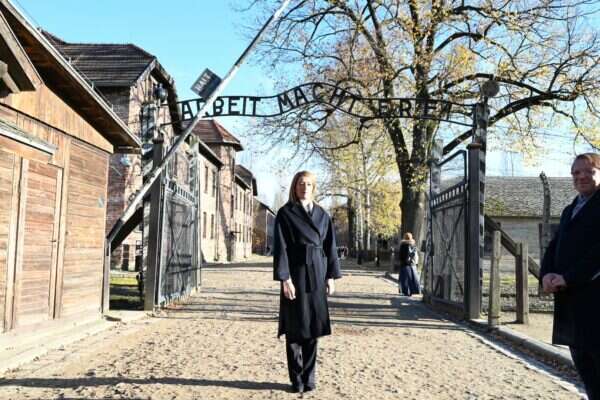

European Jewish Association to petition Holocaust bill at Polish court

Additional Articles

EU Court on Brink of Mandating Anti-Semitic Product Labeling

Pope Francis said recently that he was “concerned because we hear speeches that resemble those of Hitler in 1934.” He was talking about the rise of extreme nationalism and populism, which he feared could lead to the fragmentation of the European Union. The pope should be worried about any current resemblances in Europe to the Nazi past, but the pope’s praise of the European Union as an antidote is premature. Indeed, the European Union itself is on the verge of reviving the Nazis’ stigmatization of Jewish-made products on the pretext that they come from “occupied” Palestinian territories.
According to sources cited by the Washington Beacon, “The European Union is poised to mandate that Israeli products made in contested territories carry consumer warning labels,” which is seen by Jews as “an ominous warning sign that they say is reminiscent of Holocaust-era boycotts of Jewish businesses.” The Advocate General of the European Court of Justice recently issued a non-binding opinion to the effect that EU law requires the labeling of such products as coming from “settlements” and “Israeli colonies.” He analogized this situation to the European boycott of South African goods during its apartheid period. “The absence of the indication of the country of origin or place of provenance of a product originating in a territory occupied by Israel and, in any event, a settlement colony, might mislead the consumer as to the true country of origin or place of provenance of the food,” the Advocate General said, referring to food products. Israeli occupation and settlements could be “an objective factor which might affect the expectations of the reasonable consumer,” he added.
Brooke Goldstein, a human rights lawyer and executive director of the Lawfare Project who has fought the anti-Israel Boycott, Divestment and Sanctions (BDS) movement in various courts, remarked, “The Advocate General’s opinion said that goods produced by Muslims are to be labeled from ‘Palestine,’ and goods produced by Jews labeled as coming from ‘Israeli colonies.’ Both people are living in the same geographic location, and yet Jewish goods are being treated differently.”
Discrimination on the basis of religion is a transgression of basic human rights that violates Article 26 of the International Covenant on Civil and Political Rights.
The EU Court of Justice’s 15 judge panel is expected to issue a binding ruling mirroring the Advocate General’s opinion. If it does so, the EU court would be handing the BDS movement a major win against Israeli Jews by codifying blatant discrimination against Israeli Jewish businesses.
Consider how differently the European Union treats Turkish settlements in northern Cyprus. There are currently about 115,000 Turkish settlers and 35,000 Turkish occupation troops in northern Cyprus according to the internationally recognized government of the Republic of Cyprus. Despite Turkey’s invasion and military occupation of northern Cyprus, and the forced dislocation of tens of thousands of Greek Cypriots from their homes as Turkish settlers moved in, the European Union has allocated funds to developing and restructuring the Turkish-occupied northern Cyprus’s infrastructure. Germany, Denmark, and other European Union member countries import Halloumi cheese, a major product from Cyprus that may soon receive a “Protected Designation of Origin” from the European Union covering Cyprus as a whole. There appears to be no initiative to require further labeling of Halloumi cheese produced by Turkish settlers in northern Cyprus as coming from “settlements” or “Turkish colonies.”
On April 1, 1933, a boycott of Jewish-owned businesses broke out across Germany as the SS stood in front of such businesses to inform the public that Jews were the proprietors. The word “Jude” was smeared on store windows and the Star of David image was painted on doors to serve as anti-Jewish labels. Discriminatory laws singling out Jews followed in succession, codifying Nazi anti-Semitism. The infamous Kristallnacht, the “Night of Broken Glass,” occurred on November 9, 1938, followed by the transfer of Jewish-owned businesses to so-called “Aryans.” Germany descended from there to the “Final Solution” of the Holocaust.
Germany officially professes to remember this dark time in its history with deep regret. Last May, Germany’s legislature declared the BDS movement to be “anti-Semitic” in a resolution co-sponsored by German Chancellor Angela Merkel’s Christian-Democratic Union Party, the Social Democrats, the Green Party and the Free Democratic Party. The resolution stated that “all-encompassing calls for boycotts in their radical nature lead to the stigmatization of Israeli citizens and citizens of Jewish faith as a whole. This is unacceptable and worthy of the sharpest condemnation.”  The resolution added, “The BDS movement’s ‘Don’t Buy’ stickers on Israeli products inevitably awake associations with the Nazi slogan ‘Don’t Buy from Jews!’ and similar scrawls on facades and shop windows.”
At the same time, however, anti-Semitism is sadly on the rise in Germany as well as elsewhere in Europe. Reported cases of anti-Semitic crimes in Germany increased by nearly 20 percent last year. Attacks against German Jews have come from both right wing and Islamist extremists living in Germany. The spread of Islamist anti-Semitism in Germany has become an increasing problem in recent years as Muslim immigrants from the terrorist-prone Middle East swarmed into Germany. As the Jewish Telegraphic Agency reported, for example, the annual al-Quds Day march in Berlin has become an occasion for participants to invoke anti-Semitic stereotypes linked to their gripes against the Jewish state of Israel and to call for the killing of Israelis. Last June, a witness testified during a murder trial that a Palestinian accused of killing a German man said he had done so because he thought his victim was a “rich Jew” whose people “destroyed my homeland.”
If the European Union Court of Justice follows its Advocate General’s recommendation, as expected, it will be seen as legitimizing anti-Semitism in Europe. The court will provide one more instrument of lawfare as a weapon of war for the Palestinians and their allies to use against Israeli Jews.
the article was published on Frontpage Mag
times of israel logo

Les Juifs français les plus inquiets quant à leur sécurité parmi 12 pays européens

La France est le pays dont la communauté juive se sent le moins en sécurité, en dépit des actions menées par l’État, selon un index portant sur 12 pays européens publié mardi dans le cadre d’une rencontre organisée par l’Association juive européenne (EJA).

Cet index de la « qualité de vie juive », réalisé à partir de sondages et études, croise quatre ensembles de données : le sentiment de sécurité ressenti par la communauté juive, l’attitude de la population vis-à-vis des Juifs et Israël, l’antisémitisme et enfin la « performance du gouvernement » (statistiques sur les incidents antisémites, lieux de mémoire de la Shoah, budget destiné à la sécurité des sites juifs, liberté de culte et préservation des pratiques juives telles que la circoncision et l’abattage rituel, etc…)

Les études ont été menées par l’Institute for Jewish Policy Research de Londres et par la European Union Agency for Fondamental Rights, auprès de 16 000 Juifs européens en 2018.

Il en ressort que la France, qui comprend la plus forte communauté juive d’Europe avec un peu moins de 500 000 Juifs, arrive à la 10e position (68/100) de cet index qui concerne également l’Italie (1ère place avec 79/100), la Hongrie (2e), la Pologne (11e), la Belgique (12e place avec 60/100), mais aussi l’Allemagne, l’Espagne, le Danemark, le Royaume-Uni, la Suède, les Pays-Bas.

« L’une des conclusions, surprenante, est que le gouvernement de la France a une bonne performance » par les actions menées par l’État (score de 83/100), « mais en dépit de cela, la communauté juive exprime un fort sentiment d’inquiétude » pour sa sécurité (31/100), a déclaré à l’AFP Daniel Staetsky, auteur de cet index, statisticien à l’Institute for Jewish Policy Research.

Comme possibles explications, il a cité les « attaques terroristes antisémites » comme la tuerie de l’école juive Otzar Hatorah à Toulouse en 2012 ou l’attaque contre l’Hypercacher dans l’Est parisien en janvier 2015.

Autres enseignements de ces études : c’est au Danemark que la population juive se sent le plus en sécurité. La Hongrie arrive au premier rang concernant l’antisémitisme. Et la Belgique est dernière pour les actions menées par le pays en faveur de sa communauté juive.

Selon l’EJA, la rencontre, qui se tient à Budapest depuis lundi et se termine mardi, réunit quelque 250 personnes, dont 120 représentants et dirigeants des communautés juives d’Europe.

Dans un autre rapport publié plus tôt ce mois-ci, le rapport national des mesures gouvernementales pour lutter contre l’antisémitisme et encourager la vie juive en Belgique, le CEJI (Contribution juive à une Europe inclusive) a demandé à la Belgique de mieux enseigner la Shoah, a rapporté la presse belge.

La conclusion de ce rapport interpellait sur le fait que, dans l’ensemble, l’État belge avait peu fait pour lutter contre l’antisémitisme en tant que type spécifique de racisme. Il demandait des interventions ciblées ainsi que des efforts publics plus importants – le domaine où les politiques ayant obtenu le score le plus bas, et de loin, étant l’éducation.

« Il n’y a pas de guidance officielle par rapport à l’antisémitisme. La Shoah est enseignée, mais pas de manière consistante. Il y a des élèves à qui on n’a jamais parlé de la Shoah. Du côté francophone, il y a de nouvelles lois pour couvrir le nazisme qui vont être mises en place dans les années à venir », a déclaré Robin Sclafani, directrice du CEJI. « Les enseignants doivent être mieux formés. Il faut savoir comment enseigner l’antisémitisme par l’éducation à la Shoah contemporaine », a-t-elle ajouté.

L’idée de nommer un coordonnateur national pour la lutte contre l’antisémitisme et la promotion de la vie juive a ainsi été évoquée. L’organisation a aussi demandé à l’État d’apporter le soutien nécessaire à la mise en œuvre de la politique. Il a aussi été recommandé de mettre en place un groupe de travail interministériel durable afin de faciliter la communication et la coopération au sein du gouvernement ainsi qu’une table ronde, nationale, durable et participative, réunissant les parties prenantes dans le but de faciliter la communication et la coopération avec les organisations de la société civile afin de mettre en œuvre des plans d’action nationaux de lutte contre le racisme et l’antisémitisme.

Un consortium de recherche interdisciplinaire a aussi été recommandé, dans le but de rassembler des connaissances permettant d’éclairer la définition des politiques afin de contribuer à prévenir et à combattre l’antisémitisme et à promouvoir la vie juive. Il a enfin été demandé de fournir des ressources financières et humaines pour assurer la mise en œuvre durable de ces mesures générales.

https://fr.timesofisrael.com/les-juifs-francais-les-plus-inquiets-quant-a-leur-securite-parmi-12-pays-europeens/

German antisemitism Czar comments about public kippah wearing are a “surrender to hate” say EU Jewish Heads

“Is this the solution? Will the next advice be for me to cut off my beard? Or change my name?” asks Chief Rabbi Jacobs.
EU Jewish Association (EJA) Chairman Rabbi Menachem Margolin and Head of Governmental relations for the Rabbinical Centre of Europe Chief Rabbi Binyomin Jacobs (Netherlands) today expressed their disappointment and alarm at comments made by Germany’s respected antisemitism co-ordinatior, Dr Felix Klein, where he said that he wouldn’t advise Jews to wear Kippot (skullcaps) in some parts of the country.

The heads, representing hundreds of communities across Europe, said the comments, however well-intended towards the safety of Jews in Germany amounted to a policy of a surrender towards hate.
In a statement EJA head Rabbi Margolin said,
“It is with disappointment and alarm that I read the comments of Dr. Felix Klein. It is clear that through his work he has put the safety and welfare of the Jewish Community in Germany first, but his latest comments are a surrender to hate.
Jews cannot surrender to those who despise us. We do not alter who we are to placate the basest instincts of humanity. Dr Klein’s solution appears to be hide everything that is Jewish and then there is no antisemitism. This is a dangerous position to adopt and the EJA repudiates it in the strongest possible terms.”
Chief Rabbi Jacobs added:
“Dr Klein rightly points out the problem of antisemitism in Germany, but his well meant advice is not, to my humble opinion, the solution at all. What is next? Should I shave off my beard? Change my name? This is the road where his comments lead to. My own parents had to hide during the Nazi period. I simply refuse to hide today, nor should anyone, least of all the man tasked with fighting antisemitism in Germany, be asking us to do just that.”
Read more in dutch HERE

Mishloach Manot Handout for Purim

Purim is approaching and we are happy to announce our Mishloach Manot handout to the community has begun.
Free shipping and handling- while stocks last.
Order your Mishloach Manot here: https://purim.eu

Additional Communities
United State
United Kingdom
Ukraine
Turkey
Schweiz
Switzerland
Sweden
Spain
Slovenia
Slovakia
Serbia