Can we stop the politicization of the Holocaust? – interview

Additional Articles

Auschwitz survivor decries rise of antisemitism, far-right in Germany

Eva Szepesi tells German parliament that the Holocaust ‘began with words, it began with society staying silent and looking away’

The Times of Israel: https://www.timesofisrael.com/auschwitz-survivor-decries-rise-of-antisemitism-far-right-in-germany/

BERLIN — A Jewish survivor of the Auschwitz death camp told Germany’s parliament Wednesday that she is appalled by the rising strength of the far right in the country and increasing antisemitism in the wake of the October 7 Hamas attack that triggered the war in the Gaza Strip.

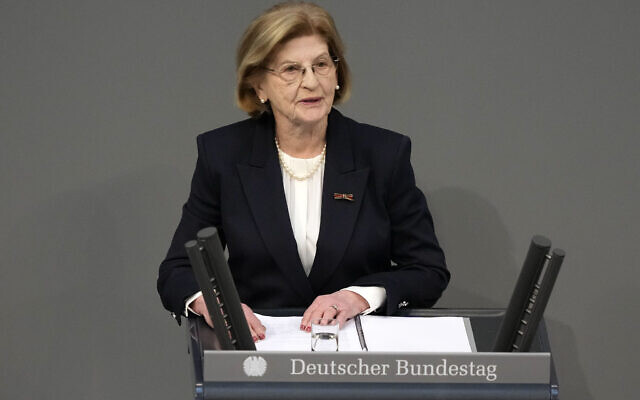
Eva Szepesi, 91, who was born in Hungary and liberated from Auschwitz at age 12 in January 1945, spoke at the parliament’s annual memorial event for victims of the Holocaust. She shared her memories of Nazi persecution and addressed concerns about the current situation in Germany.

“I would like not just for murdered Jews to be remembered on memorial days but also for living ones to be remembered in daily life. They need protection now,” Szepesi told lawmakers.

Germany saw a significant increase in anti-Jewish incidents following the attack on Israel. Szepesi said some of her readings at schools were called off for security reasons shortly after October 7 and her most recent such events took place under police protection.

“The Shoah (Holocaust) did not begin with Auschwitz. It began with words, it began with society staying silent and looking away,” she said. “It pains me when schoolchildren are again afraid of going to school just because they are Jews; it pains me when my great-grandchildren still have to be protected by police officers with machine guns just because they are Jews.”

Get The Times of Israel’s Daily Editionby email and never miss our top stories

By signing up, you agree to the terms

Szepesi also decried the strengthening of the far right in Germany, where recent national polls showed the far-right Alternative for Germany (AfD) party in second place with support of around 20%. A recent news report said some party members attended a recent meeting where right-wing extremists discussed deporting millions of immigrants and people with immigrant roots, including some with German citizenship.


The railway tracks where hundred thousands of people arrived to be directed to the gas chambers inside the former Nazi death camp of Auschwitz Birkenau, December 7, 2019. (AP Photo/Markus Schreiber, file)

“It appalls me that right-wing extremist parties are again being voted for,” Szepesi said. “They must not become so strong that our democracy is endangered.”

Hundreds of thousands of German citizens attended protests against the far right this month.

“It’s great that so many people have taken to the streets in recent weeks to demonstrate against right-wing extremists,” Szepesi told parliament. “But I would like these demonstrators also to object loudly among acquaintances and at the workplace when inhuman and antisemitic comments are made.”


POLAND REVELS IN POKING AT THE DYING EMBERS OF JEW HATRED

We shudder to think what could possibly come out of Poland next, a country that is well and truly positioning itself outside of the pale.

Poland is now beyond the pale. This expression was deliberately chosen. The Pale of Settlement was a historical region of Imperial Russia, including a large chunk of modern-day Poland, where Jews were permitted to live.
First, we had the Holocaust Law, making it illegal to critique Poland for what happened during the Holocaust, under pain of imprisonment. So I’m going to take a risk and spell out a few facts for you about Poland. As many have noted, “the few who survived Auschwitz went back and found their homes vandalized. Their jobs were taken. Their shops were confiscated. They were further welcomed by their former neighbors with slurs, curses, fists, knives, riots, broken glass, and often murder.” Just like pop singer Katie Melua’s “Nine Million Bicycles” says, “that’s a fact, that’s a thing you can’t deny.” If that appears trite, it’s because it’s meant to. The Holocaust Bill is an affront to decency, honesty and good grace. It deserves resentment, but also ridicule, for the sheer unparalleled scale of its stupidity.
And then what modicum of common sense was left in Poland’s armory of credibility also packed its bags and decided to move beyond the pale: Poland is about to make it illegal to export kosher meat and perform kosher slaughter. Oh, and for good measure, slap a four-year prison sentence on the offense.
The text of this was uncovered by us at the European Jewish Association, hidden in a 48-page general bill on animal welfare, which the lower house of the Polish Parliament is expected to vote on this week.
Back in 2013 the EJA – when a kosher ban reared its ugly head – challenged the law in Poland’s Constitutional Tribunal and won. Rabbi Menachem Margolin, our chairman and founder, has said the EJA will do so again, and also challenge the Holocaust Law.
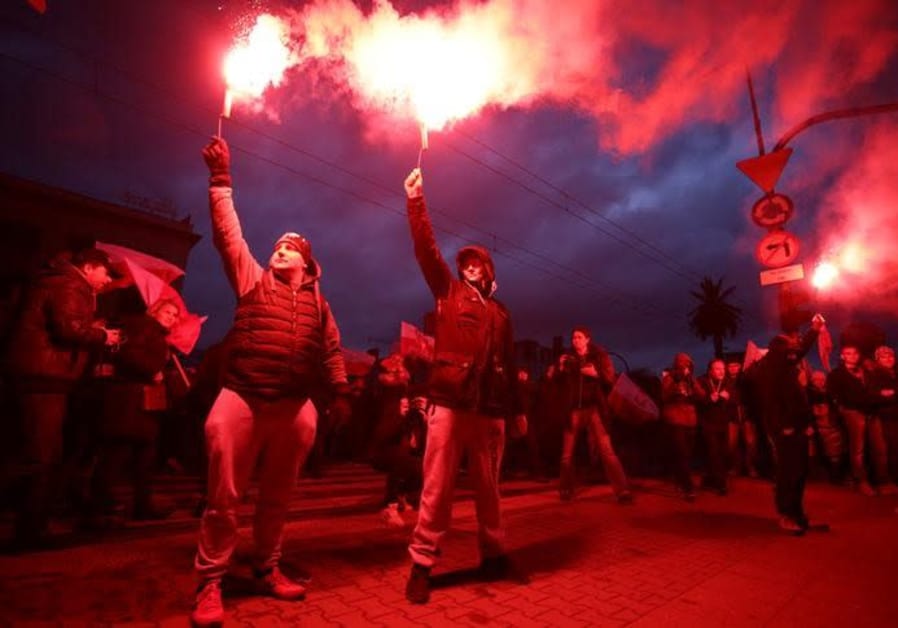
But Poland is today a very different political beast than it was five years ago. The Law and Justice Party has brought in its own brand of ultra-conservative, good old-fashioned xenophobia and parochial politics front and center, appealing to the worst instincts of a disenfranchised demographic, a trend that is increasing in popularity across the European Union to the detriment of immigrants, Muslims, Jews and anyone else who doesn’t fit the nationalistic bill.
“Panem et circenses” is now the leitmotif in Poland. So very apt. In a political context, this old Roman phrase, meaning “bread and circuses,” means to generate public approval, not by excellence in public service or public policy but by diversion, distraction or by satisfying the most immediate or base requirements of a populace.
Mission accomplished, with both these laws.
What is most alarming though is what little recourse is left to challenge it. You see, Law and Justice quickly realized that the Constitutional Tribunal was blocking their carts laden with bread and so removed the judges, replacing them with appointed party acolytes, using the smear of former communist sympathies to oust the incumbents. That means simply that gross and demeaning legislation such as this can be steamrolled through (it won’t prevent us from trying to stop them though.) Little wonder that Israel is considering withdrawing its ambassador to Poland, and little wonder that the EU is considering Article 7 as a punishment for Poland. We shudder to think what could possibly come out of Poland next, a country that is well and truly positioning itself outside of the pale.
But we shudder more that in 2018, in a supposedly modern and enlightened Europe, we even have to write opinion pieces such as this one, on subjects that stir up the hot coals of what we all thought and hoped were dying embers: Jew hatred.
This Op-Ed was written by the director of public affairs for European Jewish Association, Alex Benjamin. It was publish on The Jerusalem Post .

Is there a Western-Arab alliance (plus Israel) in the making?

On Monday, EIPA held a press briefing in Rome with Prof. Uzi Rabi, one of Israel’s leading Middle East scholars and Iran experts.

Prof. Rabi’s briefing gave detailed insight into the current trends of shifting Middle East alliances catalysed primarily by:

(1) Iran’s alliances and hegemonic aspirations; 

(2) future consolidation, projected takeover and extremist radicalisation of power in the post-Ayatollah Chameini era in the Islamic Republic by extremist factions controlled by Chameini’s son (Mojtaba Hosseini Khamenei) together with the Islamic Revolutionary Guard Corps; 

(3) Iran’s enablement of Hamas and Hezbollah in Israel’s multifront war (Gaza and the Lebanese border), Russia in its offence against Ukraine, militant groups in Iraq and Syria, etc. – all of which serve to prolong regional wars; 

(4) the tightrope balancing act that Middle Eastern states are playing in the jostling of diplomatic power between the United States and China; 

(5) Iranian activities in the drug trade in places as far away as Colombia and Venezuela and how all of this is influencing the jostling of alliances in the greater Middle East.

Professor Uzi Rabi is Principal Researcher and Head of the Regional Cooperation Programme at the Moshe Dayan Centre for Middle East and African Studies and Principal Researcher at the Centre for Iran Studies, both at the University of Tel Aviv. Previously, he was head of the Department of Middle Eastern and African History at Tel Aviv University.

Prof. Rabi’s research focuses on modern history and the evolution of states and societies in the Middle East, on relations between Iran and Arabia, on oil and politics in the Middle East and on the dynamics between Sunnis and Shiites; in this context, he has supervised the theses of numerous doctoral students in this field over the years.

Ambassadors are Like Rabbis: Reflections from Our Advisory Board Member Rabbi Binyomin Jacobs

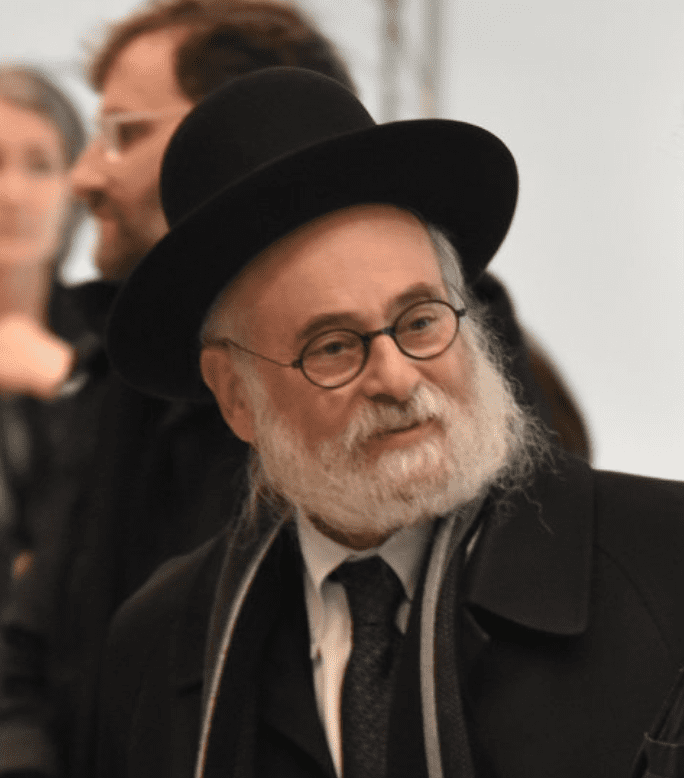
Every Day during the Corona crisis our Advisory Board Member Chief Rabbi Binyomin Jacobs (NL) writes a diary, on request of the Jewish Cultural Quarter in Amsterdam,  which is published on the website of the NIW, the only Jewish Dutch Magazine. Rabbi Jacobs is the head of Inter Governmental Relationships at the Rabbinical Centre of Europe. We will be regularly publishing a selection of his informative, sometimes light hearted, but always wise pieces.
For our Dutch readers you can follow the diary every day at NIW home page: https://niw.nl and then: scroll down.
Ambassadors are like Rabbis…
Today was all about abroad. The Ambassador of Hungary had invited me to lunch at his embassy. We have known each other for a few years, meet from time to time and so again today. Reason for the visit? No. Just catching up again about kosher slaughter, which was threatening to become a problem in Poland and the relationship between Hungary and Israel.
Because it would not be exactly easy to arrange a kosher meal at the Hungarian embassy, ​we (my wife and I) invited him to lunch with us.
So,the ambassador came to Amersfoort and we not to The Hague. Not wanting to come empty-handed, he brought a huge bouquet of flowers and a bottle of kosher wine.
How did he get that wine? The ambassador called his friend Naor (the ambassador of Israel) and he arranged for a bottle of kosher Israeli wine from the IPC – the Israel Products Center – in Nijkerk to be delivered to the Hungarian embassy that morning. And because the Ambassador of Hungary did not know about the existence of the IPC, which is ten minutes from my house, I took him there after lunch. Of course I made sure that in addition to the tour and explanation about the objective of IPC and Christians for Israel, he also received a pack of cookies. Because: tomorrow the ambassador of Israel will visit the Hungarian ambassador and then it seemed nice that I then pay back the bottle of wine via a roll of kosher Israeli biscuits.
Apart from that, I gave the ambassador a mask with “I love Israel” on it, so that the Hungarian ambassador can wear it when the Israeli ambassador comes to make his appearance.
Networking is something like that. Usually it does not deliver on the spot, but is important nonetheless. Ambassadors do no different, and are a bit like rabbis, at least my kind of rabbis.
Because I believe that the rabbi is of course primarily there for the Jewish community in its full breadth. But for that Jewish community, contact with outside that community is also of vital importance, because we are part of the wider society: Noah had to leave the Ark by order of Gd!
Apart from the importance for the Jewish community, we also have a duty, in my opinion, to contribute to the well-being of the surrounding society. Yesterday I had a visit from another kind of ambassador, namely Dr. Pieter de Boer, member of the deputy Church and Israel of the CGK-Christelijk Gereformeerde Kerken- and spokesperson of the Interkerkelijke Werkgroep. That Working Group had drawn up a statement of guilt on the attitude of the churches during and shortly after the war. Today, that statement of guilt was officially released.
Although for me such a debt declaration is not really necessary, I was especially touched by the comment about what went wrong after the war. My grandfather and grandmother’s nephews and nieces were not allowed to be raised with my grandfather and grandmother, but were to remain in the Christian homes where they had been in hiding. Of course, those parents had bonded with the kids, saved their lives, but … they really hadn’t given up their murdered parents with the intention of being raised as Christians.
And whilst with the ambassador: a phone call from Ukraine. One of the rabbis was in a conflict with Christians for Israel supporting him with an adoption project. People in the Netherlands adopt a poverty-stricken Jewish family in Ukraine for € 25 per month. In Kirovograd, communication between the Dutch donors and the local rabbi did not go well. And so I get a call from the rabbi and start mediating or solving, as a kind of ambassador of whom I really don’t know, but I am somewhere in between.
After the necessary phone calls, I hope that I have been able to straighten everything out again and that it also runs smoothly in Kirovograd. What is difficult here is that the local rabbi speaks fluent Russian, but no Yiddish, poor English and not optimal Hebrew, and certainly no Dutch! But I believe I’ve been able to tie things together again. In the meantime, I am waiting for the results of an archival investigation to confirm someone’s Jewishness. I feel that it can be checked that way, but not everyone shares my opinion that (almost) everything should be tackled immediately. In principle, I always answer e-mail immediately.
As a result, I sometimes spend late at night behind that stupid computer that has been controlling my whole life!
But Good news! At least in my opinion. Because, of course, it is really not the case that a hundred listeners are more important than ten at a lecture, and the same goes for the number of readers of my diaries, still, I have to admit my weakness in this, I like that my diaries are getting wide read. And so: Good news for me! Coincidentally (although I really believe that coincidence does not exist) the EJA –European Jewish Association- saw one of my diaries, translated it with Google and asked permission to post this diary a few times a week on their website and their Facebook. And thus more readers. My diary is going European!

Additional Communities
United State
United Kingdom
Ukraine
Turkey
Schweiz
Switzerland
Sweden
Spain
Slovenia
Slovakia
Serbia