“I stress time and again that most victims of ISIS are Muslims. And when a topper from our government said to me, when we were discussing anti-Semitism, that in the Netherlands today 98 per cent of anti-Semitism comes from Muslims living in our country, I pointed out to him that when 80 per cent of my family was murdered there was not a single Muslim to be seen in the Netherlands,” I wrote in my diary of 7 February. Let me add that the day after 7 October, I received a phone call from our minister of general affairs, Van Gennip, who asked interestedly how I was doing and told me that “both the Moroccan and Turkish communities in the Netherlands do not find the events of 7 October acceptable”.
Probably I am a little too naive, because as far as I know, no mosque or Islamic community has dared to publicly distance itself from the 7 October massacre. Yes, a number of befriended imams let out a sincere and condemning sound in a personal conversation (I will not mention their names here, to avoid getting into Islamic trouble), but the Islamic silence at the time and the anti-Israel demonstrations at the opening of the Holocaust Museum and the anti-Herzog call by two hundred mosques do not make me feel good and worry for the future of Jewish Holland. Where were those two hundred mosques immediately after October 7? And I dare even ask myself: is there any future for the Jewish community in my homeland?
And the Netherlands is my homeland! Through my father’s line, I am the fourteenth generation after Chief Rabbi Moses Uri Halevi, the founder of the Portuguese-Israelite Congregation in Amsterdam. His congregation made Amsterdam into Amsterdam, put the city on the map and thus made a gigantic contribution to today’s Mokum. This makes it all the more painful to see the anti-Israel demonstrations and the enormously rising anti-Semitism close to the place from which 46 thousand Amsterdam Jews were deported on the trams of the GVB in World War II to end up, via Westerbork, on the trains of our own Dutch Railways, finally via the chimneys of the crematoria in the extermination camps in the dark hole of oblivion.
I dare even ask myself: is there any future for the Jewish community in my homeland?
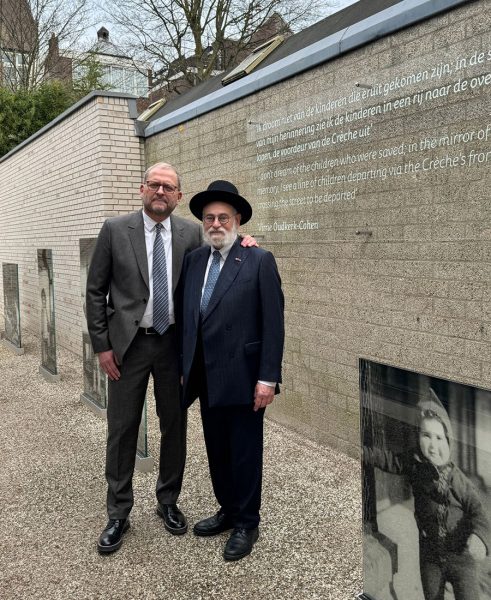
How was the official opening of the Holocaust Museum? King Willem-Alexander, the president of Israel, the president of Austria and the chairman of the German Bundesrat spoke impressive, well measured words. The music, the speech by my friend Emile Schrijver, director of the Jewish Cultural Quarter, the other speakers, the voices of survivors, the children and the master of ceremonies Petra Katzenstein. If I wanted to properly put into words the impression this unforgettable, historic day made on me, I would read a few lines without words.
Every word I would write would be one too many, because the opening, the ceremony, the togetherness transcended all words. It was a deeply emotional event. Words describe, but words also limit and so: not a word I can dedicate to it.
And yet something also went wrong, wrong. Throughout the happening, anti-Semitic protests were heard. While the speakers were not drowned out, the music remained audible, their roar was like false-sounding background music, which, while not distracting from the perfect programme, demonstrated how necessary the Holocaust Museum is. In my opinion, the emotional damage done to survivors present was not adequately taken into account. And although, thank God, I was born only after the war, I too felt brutalised by the shouting crowd. I cherish freedom of speech, but the bestial manner in which I was shouted at, and with me so all those who came outside the Snoge, I find unacceptable. I do not understand why this was tolerated. The location from where the chanting was carried out was also painful: Waterloo Square, the source of Jewish life in the Jewish quarter at the time!
During the ceremony, fortunately I had my phone set to ‘do not disturb’, as a number of calls had come in from enraged Jewish people who, I later learned, found it unacceptable that protests were allowed and guests were allowed to be booed as they left the Snoge. At the amazing lunch at the Jewish Museum and especially when touring the Holocaust Museum, I was able to provide a lot of pastoral care. Many felt deeply hurt and abandoned … Yet, the feeling of gratitude and joy that this great monument was officially opened prevailed with everyone.
I cherish freedom of speech, but I find the bestial way I was called names unacceptable.
With this afternoon’s anti-Semitic roar still buzzing in my ears, I watched the documentary on the Jewish Council. It won’t be too bad, it was thought at the time. And so the Jewish Council was established. How do we view the growing anti-Semitism in 2024? Will it not be too bad?
But I must stop now to pack my suitcase and then quickly go to bed. Tomorrow at six o’clock the taxi will arrive and I will be on the plane at ten to eight on my way to Oporto for a three-day conference on kashrut. I hope and expect to learn a thing or two there. Keynote speakers from the rabbinical world, experts on kashrut, will give the speeches. I also have to speak, but what and where is not quite known yet. Probably at the unveiling of the monument being unveiled there in memory of the victims of 7 October.
And meanwhile, I float between my bed and the documentary on the Jewish Council, meet the grandsons of Asscher and Cohen, the chairmen, and wonder whether I am alarmist or realist. Cohen’s grandson fights with me against rising anti-Semitism. I don’t feel myself more unsafe than usual, but anti-Semitism is getting closer … am Jisraeel chai!
Een onvergetelijke dag