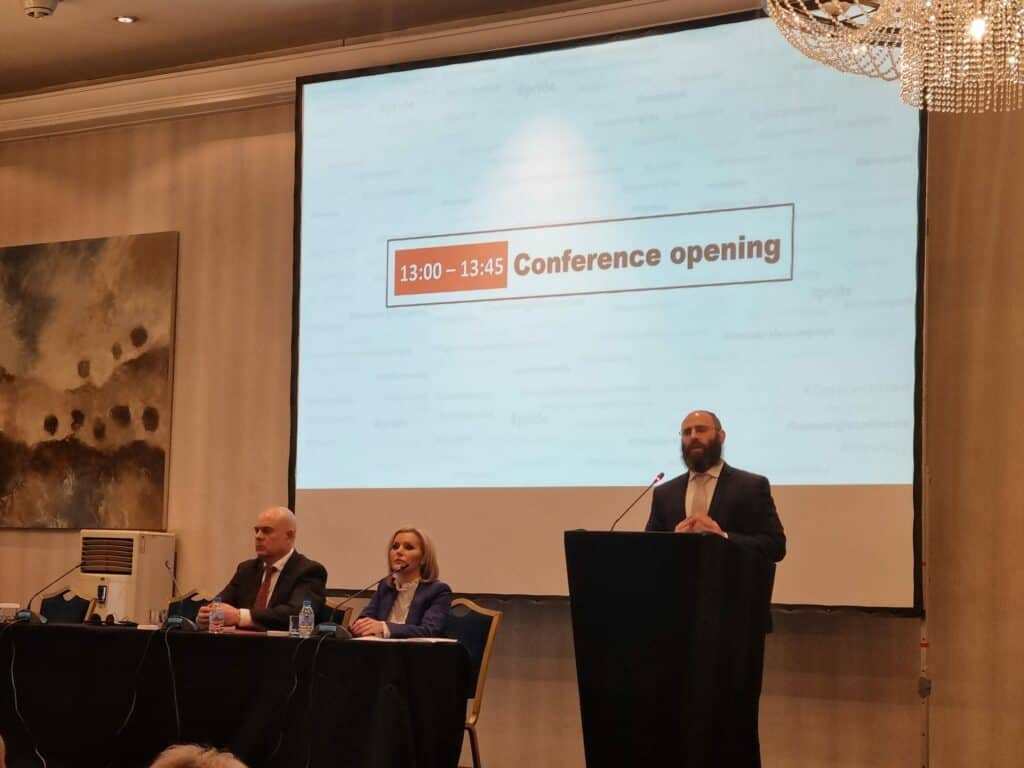
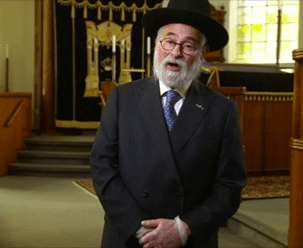
A special message for Shavuot from Chief Rabbi Jacobs.

Shavuot starts on Thursday evening. For those of you lucky enough to understand dutch, we are pleased to share with you this deeply inspiring message from our esteemed EJA Board Member, Chief Rabbi Jacobs from the Netherlands, for those of you that don’t, we had it translated for you. Wishing you all a Blessed and Happy Shavuot Holiday.
Chief Rabbi Binyomin Jacobs shares his vision in these complicated times from the synagogue in Amersfoort.
Judaism has many traditions and laws.
But there is one law that remarkably doesn’t fall under the 613 commands and prohibitions.
It just doesn’t exist and that is the prohibition on being depressed.
What I mean is there are people that see everything darkly. They see everything in a negative way and don’t look for the positives. They always focus on the negative side. So why is there no law against this?
The answer to that question is, being depressed is not a violation but it stands higher (or lower) in a way than a regular law. Because it leads to the biggest of violations.
This perspective looks at everything that can go wrong. It’s like only looking at the negative potential side-effects of medicines and forgeting that the purpose of the medicine is to cure.
Such a way of life is not only one violation but is also the root for a lot of misery in mental health.
And because body and mind are connected, it also has effects on your body.
A negative and depressed attitude is a source of misery, mental and physical.
I wrote a column once about a tightrope walker. A tightrope walker shouldn’t look only upwards and blindly trust in the Eternal that all ‘it will be alright.‘ But equally only to look down into the abyss is not good.
There is a happy medium. A balance between up and down. Otherwise the tightrope walker will never make it to the other side.
In a way we are all tightrope walkers. All the time we need to find a balance between the Eternal and the fact that there is indeed an abyss.
Another point: A man grows up in the jungle. He knows nothing of the civilised world.
His view never got further than the trees and the jungle. His jungle. This man gets lost and arrives in a city.
He looks at everything. He walks around surprised. He walks into the door of a big building into the hallway, walks up the stars and goes unto the balcony. Below him he sees a large room. In that room men and women walking around with face masks on. On the wall he sees tools, saws, drills and more intruments.
In the middle of the hall stands a high long table. On that table lies a white sheet. Under that sheet a human foot stick out. A nod is given, and some men and women start to cut into it.
Blood sprays out and our man from the Jungle passes out. He has never seen something so sadistic. Of course, he ended up in the operating room of a hospital. The person on the table, in the hospital bed, was sick and was being cured by the doctor and the nurses. Our man sees only the painful operation. He does not know the context that that the patient was sick and is being cured by this operation.
Life is like an operation. There is something before and something after. But if we only witness the operation then that’s the only thing we see. What there was before and what comes after, removes itself completely from our vision.
More than ever, today we all feel that we are undergoing an operation.
Is it a punishment? A reward? Meaningful? Meaningless? It’s always good to keep a mirror in front of yourself. But to firmly embed yourself into feelings of guilt, putting yourself into a depressed condition, that should never happen.
We cannot understand life like our man from the Jungle.
Serve G-d with joy. Are we able to do that? Or a better question: can I do that?
A parable is told of 2 strong cool guys (someone like me). Both are standing at the foot of a mountain. Both have an empty burlap sack on their shoulders. The contest can start.
The starting gun is fired and both guys need to, while climbing, fill their sacks with rocks.
After 3 hours they have a same amount of rocks in their sacks. Both climbed to the same height. But one is pale and cannot clime any higher.
The other is singing with joy and walks with big steps. How is this possible? That one is so heavily burdened but the other does not feel it? Both have the same health and strength. Both have the same amount of rocks in their sacks. But the guy that cannot climb a single step further thinks he is carrying kilos of stupid rocks. The more rocks he is collecting, it gets heavier and heavier.
His buddy knows that it is not just rocks. Its precious stones and diamonds. The more diamonds he gets into his sack, the lighter and lighter it gets.
How do I choose to look at all the things that I am enduring in my life?
When I’m speaking to a lot of people as a rabbi, I learn a lot. People are in situations that are heavier than mine. But they take every load as a diamond. I learn from their strength and self-control.
They hold a mirror in front of me.
That is Judaism.
To learn from someone else.
And it’s also Judaism to see the heavy load not as it is.
It’s also Judaism that when you notice an unexpected a shortcoming in someone else, you are aware that it also can be present in you.
If you did not know that this shortcoming was what it is, you would not recognize it in yourself.
And at the same time, alertness.
Alertness of the rise in antisemitism that is far from vanished and vanquished.
Our minister of Justice and Security is also Minister of Worship.
And when I spoke to him about restarting our worship, he warned me about the lone wolf.
Especially during the pandemic. But it is also, alertness to the physical rules that should protect us against that terrible virus.
When we can go to shul, the church or the mosque, we shouldn’t just trust that everything will come from above.
Because when that tightrope walker only looks up, he won’t make it.
On Thursday we start the holiday of Shavuot. The Jewish people stood as one at the foot of the Sinai to receive the 10 commandments, the 613 mitzvot and the Torah in its totality.
They saw G-d. There was something in common and that brought them together. There was unanimity. For division, fights and tensions there was no room.
In this time of Coronavirus, it is not only the Jewish people that have something in common, but the whole of humanity: a common enemy. From it we should liberate ourselves. But it’s an enemy of everyone, without any form of discrimination.
Let us pray that that enemy will be beaten in our days, exterminated and that the unanimity that the virus has made, will stay.
May there be speedily in our days eternal shalom – peace – for the whole of humanity, real peace for everyone.
You can hear the words of Rabbi Jacobs in dutch HERE
Additional Articles

EJA Meeting with European Parliament Vice-President Roberta Metsola

The EJA was proud and honoured to welcome European Parliament Vice-President Roberta Metsola to our Headquarters for a meeting.
Vice-President Metsola is responsible for Article 17 matters: Dialogue with churches, and religious and philosophical organisations, and is deeply committed to ensuring the safety and wellbeing of European Jewry, particularly in light of rising antisemitism due to the pandemic, but more recently the surge in antisemitic sentiment related to the recent Gaza conflict.
The EJA noted with appreciation the Vice-President’s fire and determination on combatting antisemtism and countering ignorance about Jewish life, practice and faith in Europe. In a political environment often marked by platitudes, such an approach was wonderfully refreshing. We agreed to pursue a number of projects and activities together in the months ahead and look forward very much to deepening our relationship with Mrs Metsola and her capable, efficient and dynamic offices.

Taking Action Following the Murder of Yeshiva Student, Dvir Sorek (ת.נ.צ.ב.ה)

A day after Dvir funeral EJA chairman, Rabbi Margolin had sent letters to High Representative Mogherini, H.E. Mr. David Maria Sassoli MEP, H.E. Mr. Donald Franciszek Tusk and Mr. David James McAllister MEP, urging them to condemn the glorification of violence and radicalisation by the Palestinian Authority, and make clear that incitement will not be tolerated by the EU, in order to ensure that the murderer of the 19-year-old Dvir Sorek does not receive such payments/stipends.


The Intolerance of Demanding that Meat Slaughtered According to Jewish Ritual Be Specially Labelled

By Rabbi Menachem Margolin (05/02/2014)
Recent months have seen revived attempts by politicians, both in the European Parliament and as domestic level in various EU member states, to legislate on the sacred ritual tradition of Jewish animal slaughter. A September draft written declaration in the European Parliament called on the Commission to instigate special labelling for the meat of ritually slaughtered animals, to eliminate “misleading omissions liable to distort the transactional decisions of consumers”, whilst claiming that consumers should have the right to ensure the meat they are purchasing comes from animals that have been slaughtered with proper regard to animal welfare.
The Polish parliament dismissed a government-sponsored bill to protect the religious slaughter of animals, whilst their Lithuanian counterparts voted in legislation aimed at protecting the practice.
The ability to eat kosher meat is a fundamental right for all people. The fact is that many people prefer to eat kosher meat simply for health reasons, regardless of religious beliefs or considerations.
Of course, everyone must respect the public’s right to know; there is no question that it is fair and correct to require listing a food’s ingredients on the label. Nevertheless, it is clear that the calls of a number EU member states to label meat slaughtered according to religious ritual as such, sets off many alarms – history has shown that such demands have led to large-scale bloodshed (human, not animal blood).
Did these pluralistic liberals, before attempting to isolate their neighbours who subscribe to different lifestyle choices, ascertain whether or not traditional kosher slaughter causes more harm or abuse to animals, G-d forbid, than other methods of slaughter? Had they conducted that research, they would have discovered that countless objective authorities agree that religious slaughter – both by Jewish and Muslim doctrine – is the least painful method of animal slaughter. In fact, the Jewish kosher slaughter code requires that no less than thirteen steps be taken before an animal may be slaughtered. One of these requirements is to verify that the animal is not hungry or thirsty when it is slaughtered.
If those “enlightened” individuals were truly concerned about animal rights, they would declare war on all forms of slaughter. Animal rights are not guaranteed by disparaging one particular method of killing animals, whilst allowing others to continue unabated, including hunting or factory slaughter?
And if allowances must be made, considering most people consume meat top some degree, and our decision-makers choose instead to legislate on the most humane method of slaughter (is it humane to put a living thing to death in any manner?), they ought to worry about the conditions in which animals are raised before their slaughter. They should be concerned about ensuring
sufficient living space, quality and quantity of food, medications, comfort level during  transportation for slaughter, quality and wattage of the electric shocks administered for slaughter, the number of shots needed to kill an animal, and more.
The number of animals slaughtered each year according to kosher standards is less than 1 percent of those slaughtered by other methods. If the issue in question here is the public’s right to know, what logic is there in demanding that kosher meat be labelled, without addressing the 99.9 percent of the slaughtered animals in the country?
For the past 3,000 years, the Jewish people have had to deal constantly with innumerable attempts to infringe upon their freedom of religion – a liberty that has long been established as a basic human right.
As well as being illogical and inconsistent from the perspectiveof animal rights, labelling kosher meat will give ammunition to anti-Semites to attack Jewish tradition. It is very disturbing to note that people who claim to be enlightened liberals are advancing this motion. These people who present themselves as pluralists are, perhaps unwittingly, waging an all-out war against anyone who chooses to live differently from them.
In the 1930s, things began with the burning of books and ended with the burning of human beings. I shudder to think how this new discrimination, beginning with methods of animal slaughter, will end.

European Commission head to light Chanukah candle on Rond-Point Schuman in Brussels’ EU quarter

The President of the European Commission, Ursula von der Leyen, will celebrate Chanukah on Monday 19 December  by lighting the flame on a large menorah in front of the European Commission’s headquarters in the Brussels EU quarter.

As part of the cultural agenda of Brussels, the city’s Mayor Philippe Close will light the second candle of Chanukah.

The event is  seen as a strong sign for the European Jewish community in the wake of the EU’ clear commitment to ensuring a Jewish future and fostering Jewish life as laid out in the EU Commission’s new strategy for combatting resurgent antisemitism and fostering Jewish life in Europe.

European ambassadors and civil servants are expêcted to attend the event.

The lighting, which is organized in partnership with the European Jewish Association and the City of Brussels, will take place on Monday at 18:00 on Schuman Square and will be followed by a concert from the singer Haim Tzvi.

Chanukah, the Jewish festival of lights, is one of the most popular Jewish holidays worldwide. Candles are lit over 8 days to remember the miracle of one day’s worth of oil lasting eight following the reconsecration of the Temple in Jerusalem. Its message of hope, light and emancipation resonates are universal and timely. Celebrations worldwide are attended by heads of states who often light their own candles.

In addition to Monday’s lighting, Chanukah will also be celebrated the next day in the European Commission with the presence of the European Commissioner Janez Lenarčič, honoring Hias Europe, the world’s oldest refugee organisation, first established in the 1880s to help Russian Jews fleeing from pogroms resettle in the United States. Since then, HIAS Europe has had a strong presence throughout Europe, resettling hundreds of thousands of European Jews fleeing from violence and conflict. Today, HIAS Europe is a global humanitarian organization with thousands of employees in 22 countries dedicated to helping forcibly displaced persons, irrespective of their background. During more than a century of activity, HIAS Europe has helped more than 4.5 million people escape persecution worldwide »

EuroChanukah is organised every year by the European Jewish Community Centre (EJCC).

Additional Communities
United State
United Kingdom
Ukraine
Turkey
Schweiz
Switzerland
Sweden
Spain
Slovenia
Slovakia
Serbia