
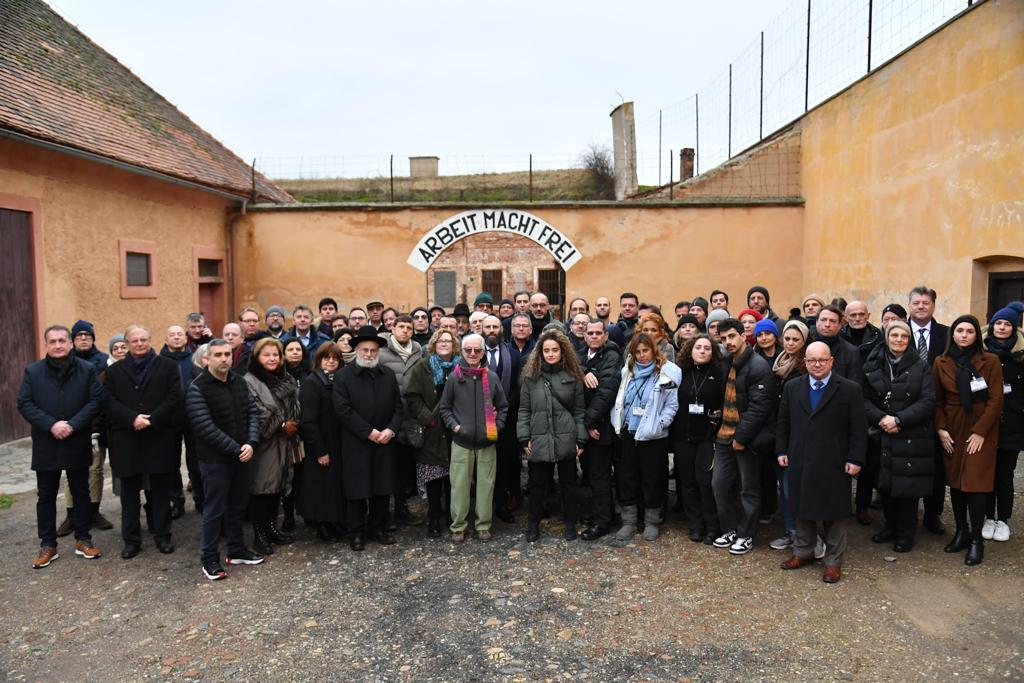
A short video from the eja delegation to Prague

Additional Articles

A new memorial tombstone on a mass grave of Jews in the City of Sadigora, Ukraine

The Rabbinical Center of Europe (RCE) has unveiled yesterday morning a memorial tombstone on a mass grave of  the Jewish community of the City of Sadigora in Ukraine, that were slaughtered in 1941 by gangs of Ukrainians and Romanians that were granted “24 hours to do what they wanted with the Jews” by the Russian Command
“We played together – all of the children and suddenly our Jewish friends began to disappear”
RCE General Director, Rabbi Arye Goldberg:
“We are in the midst of an extensive operation to detect and establish tombstones on other mass graves of Jews who were slaughtered in Ukraine”
Israel‘s ambassador to Ukraine, Joel Leon:
I call upon the new President of the Ukraine and Members of the Rada (parliament of Ukrain to adopt the Anti-Semitic definitions of the IHRA
Thursday, July 25, 2019, Ukraine, The Jews of Sagura in southern Ukraine, near the border with Romania and Moldova, thought that the Russian army’s victory over the German Nazi army during the fighting in the region in July 1941,  was the end of the war, and the end of the attacks on them by the Romanian Army who controlled the area and cooperated with the Nazis.
However, the Russian command allowed local Ukrainian and Romanian gangs a “24-hour window to do with the Jews as they will”. The relief sensations of the Jewish community of the region became a murderous nightmare: “We played together – all of the children and suddenly our Jewish friends began to disappear one by one” said this morning in a trembling voice, an elderly Ukrainian woman who was present at the time of the acts during the unveiling ceremony of the tombstone established by the  Rabbinical Center of Europe over the mass grave in which , about 1,200 Jewish children women and men were murdered and burried – some of them when they were still alive.
The mass grave and the hidden testimonies were found in part by Rabbi Mendi Glitzinstein of the nearby city of Chernivtsi who harnessed the RCE in order to establish a headstone on the mass grave. The unveiling ceremony that took place this morning, saw the distinguished presence of the district’s Governor, Eiom Vasilovitz, , Israel’s ambassador to Ukraine, Joel Leon, RCE General Director, Rabbi Arye Goldberg, Chief Rabbi of the nearby Jewish Community of Jetimore and Western Ukraine, Rabbi Shlomo Wilhelm, members of the small Jewish community who survived  the massacre and Ukrainian neighbors, some of whom testified how they could feel the “earth burning underneath their feet” even days after the terrible massacre took place.
RCE General Director, Rabbi Arye Goldberg, said during the ceremony that the Rabbinical Center of Europe,  and its over  700 rabbi Members across the continent,  took this very important mission upon itself  and is now in the midst of an extensive operation of  locating and establishing tombstones on other Jewish mass Graves in the Ukraine. “We collect evidence and testimonies as much as possible from elderly Jews and Ukrainians who still remember. We than locate the mass graves and only after a team of experts confirms the findings, we establish tombstones for the memory of the victims.”
RCE and EJA Chairman, Rabbi Menachem Margolin, made it clear that the special activity for locating and establishing tombstones on the tombs of the victims was held in parallel with the effort to further and renew Jewish life throughout the Ukraine, as well as the restoration of synagogues and mikvehs.
Israel’s ambassador to Ukraine, Joel Leon who carried the Kaddish prayer in the ceremony, thanked the RCE for the initiative and its implementation in the field, and said that the embassy was conducting a special program for training Ukrainian teachers on how to teach the  lessons of the Holocaust in schools throughout the country. I call upon the new President of the Ukraine and Members of the Rada (parliament of Ukrain to adopt the Anti-Semitic definitions of the IHRA


IRAN REGIME ALLIANCES: DESTABILIZING INFLUENCES IN EUROPE AND MIDDLE EAST

Thousands in Budapest flock to Jewish street fair in sign of community’s revival

In scene uniting Jews of all denominations, some 10,000 brave thunderstorm to throng Hungarian capital’s touristic Kazinczy street for annual Judafest

BUDAPEST – Thousands flocked to Budapest’s Kazinczy street in the heart of the historic Jewish ghetto on Sunday to celebrate the city’s Judafest.
Braving an afternoon downpour, tourists and locals alike visited the massive street festival, which annually showcases all things Hungarian and Jewish. It’s quite a coup for a central European Jewish community still recovering from World War II and decades of Communism.
The thoroughfare, a common tourist destination throughout the year, teemed with both Jewish and non-Jewish onlookers who stopped at the dozens of stalls offering traditional Jewish foods, handmade items for sale, and information on the multitude of religious and community initiatives that operate in Hungary and the surrounding areas.
Parents pushed baby carriages and walked hand-in-hand with children who sported brightly colored face paint and clutched balloons decorated with the logos of Jewish organizations.
“I think we have even more people than last year,” festival organizer Pepe Berenyi told The Times of Israel. Berenyi, who is also the deputy director of Budapest’s Balint House JCC, estimated that 9,000 to 10,000 people had passed through the festival by mid-afternoon.
Judafest perennially brings together congregations and organizations from all walks of Hungarian Jewish life and across secular and all religious denominations — no mean feat for any Jewish community. The festival was organized by Budapest’s Balint House JCC and the American Jewish Joint Distribution Committee, and featured over 30 partners from across the community.
This year also saw significant representation from the country’s periphery and Israel, including the towns of Koszeg, on the Austrian border, and Komarom, on the border with Slovakia – in keeping with the festival’s theme of “Hungarian-speaking Jewish communities.”
A secular humanitarian organization set up shop across from Chabad Hasidic emissaries who gave passersby the chance to say a short prayer with a set of phylacteries. Representatives from many of the city’s various synagogues lounged together amid the many food stands offering tastes of traditional Jewish fare ranging from cholent to freshly baked challah to plates of Israeli hummus.
In the late afternoon, the sunshine gave way to heavy gray storm clouds when a not-completely-unexpected thunderstorm struck. But revelers stuck it out, huddling with umbrellas for half an hour in stone alcoves along the alleyway. As the rain finally started to let up, a handful of teenagers with matted hair took back to the street and danced in their wet clothing to Israeli music that continued to play from a nearby stall.
“Well, it was a great six hours,” joked a resilient Berenyi, who worked for months to put the festival together.
But despite some setbacks – the amplification system and other electronics were taken out of commission by the storm – visitors did not seem deterred. Stall owners bailed out water, dried off their merchandise, and went back to serving the many attendees who stuck around.
A planned concert went forward as an acoustic performance, and the three singers made up for the lack of a sound system by asking the audience to accompany them, turning the show into a sing-along.
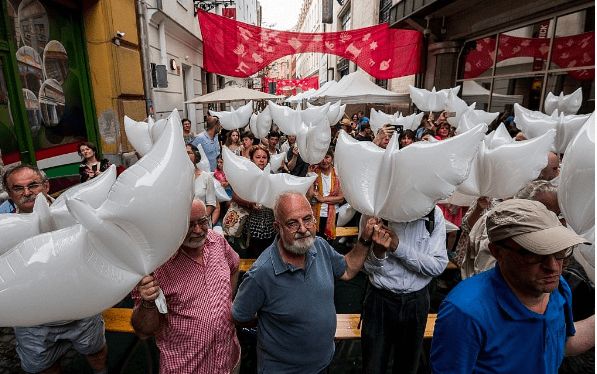
At 19:48 Israeli time, to correspond with the year Israel was established, 70 community dignitaries released dove-shaped balloons in honor of Israel’s 70th year of independence.
Onstage, Balint House JCC director Zsuzsa Fritz sang “Lech L’cha,” by singer Debbie Friedman, citing the song’s significance.
“The song is taken from the biblical passage where God first commands Abraham to go to Israel, and promises to bless his offspring and make them into a great nation,” Fritz later told The Times of Israel. “I really felt that this was especially appropriate here as we continue to grow our community.”
Fritz said that the event was an incredibly effective outreach tool, and could encourage many people to engage with Budapest’s Jewish communal life who otherwise wouldn’t take the initiative.
Berenyi said that in Judafest’s inaugural year, Hungarians were hesitant about street festivals of any type – let alone obviously Jewish ones. In all, there were seven partners that first year, and, unexpectedly, the daylong festival was a huge success, drawing 2,500 people.
But in recent years, Judafest has grown considerably, attracting dozens of partners and drawing 12,000 attendees.
Fritz cited an impact study that the Balint House JCC conducted at the event, with pollsters asking attendees questions related to their levels of Jewish participation.
“I was walking by and overheard one of our surveyors speaking to a woman of about 60,” Fritz told The Times of Israel.
“She asked the woman if this was the sole Jewish event that she attended this year, and to my surprise, the woman answered yes,” Fritz said.
“I was sure that she looked like she participated more regularly – in this business you get a feel for these things – but this just shows that events such as this are of the utmost importance and can bring people into the fold who otherwise would feel insecure.”
The article was published on The Times of Israel

Open letter to the federal Belgian negotiators,

Brussels, 27 January 2025 – In an open letter, leading Jewish associations and the Belgian League against Anti-Semitism have addressed the leaders of the upcoming Belgian government.

The letter, signed by the European Jewish Association (EJA), the Ligue belge contre l’antisémitisme (LBCA) and the Joods Informatie- en Documentatiecentrum (JID), outlines key concerns of the Jewish community that they hope to see addressed in the new coalition agreement. The letter is being accompanied by an extensive online communication campaign to highlight this action and to involve citizens in the initiative.

  1. Increased security

The letter highlights the need for increased security measures for Jewish institutions in light of the increased risk of attack, as identified by national security organisations. It calls for both temporary and structural reinforcements to ensure the safety of the Jewish community and implores the appointment of a federal security advisor to coordinate these matters.

  1. Combating Jew hatred

The letter calls for the appointment of a special coordinator to combat anti-Semitism, an initiative already adopted by several European countries. This coordinator would be responsible for monitoring Jew hatred and developing strategies against this growing threat, particularly in view of the worrying increase in anti-Semitic incidents in Belgium.

  1. Freedom of religion

As Europe continues to secularise, the letter underlines the importance of recognising and protecting religious freedoms. The Jewish community seeks assurances that its right to freedom of belief will continue to be respected and protected, and stresses the importance of constructive dialogue on sensitive issues.

The call to the new government is clear: take the concerns of the Jewish community seriously and integrate their needs into policy. The letter concludes with an invitation for partnership in the hope that, despite the tragedies of the past, the Jewish community can look forward to a dynamic future.

It is now up to the leaders of the coalition government in formation to respond to this call and to show that Belgium recognises and protects the value and contributions of its Jewish citizens.

Download the letter in PDF

https://acrobat.adobe.com/id/urn:aaid:sc:EU:8cd61633-824b-4f06-a19f-b8a607728615

Additional Communities
United State
United Kingdom
Ukraine
Turkey
Schweiz
Switzerland
Sweden
Spain
Slovenia
Slovakia
Serbia